 Branding
 Digital Marketing
 Web & App Dev
 IT Services
Your Next AI Investment Might Be in Infrastructure, Not Intelligence
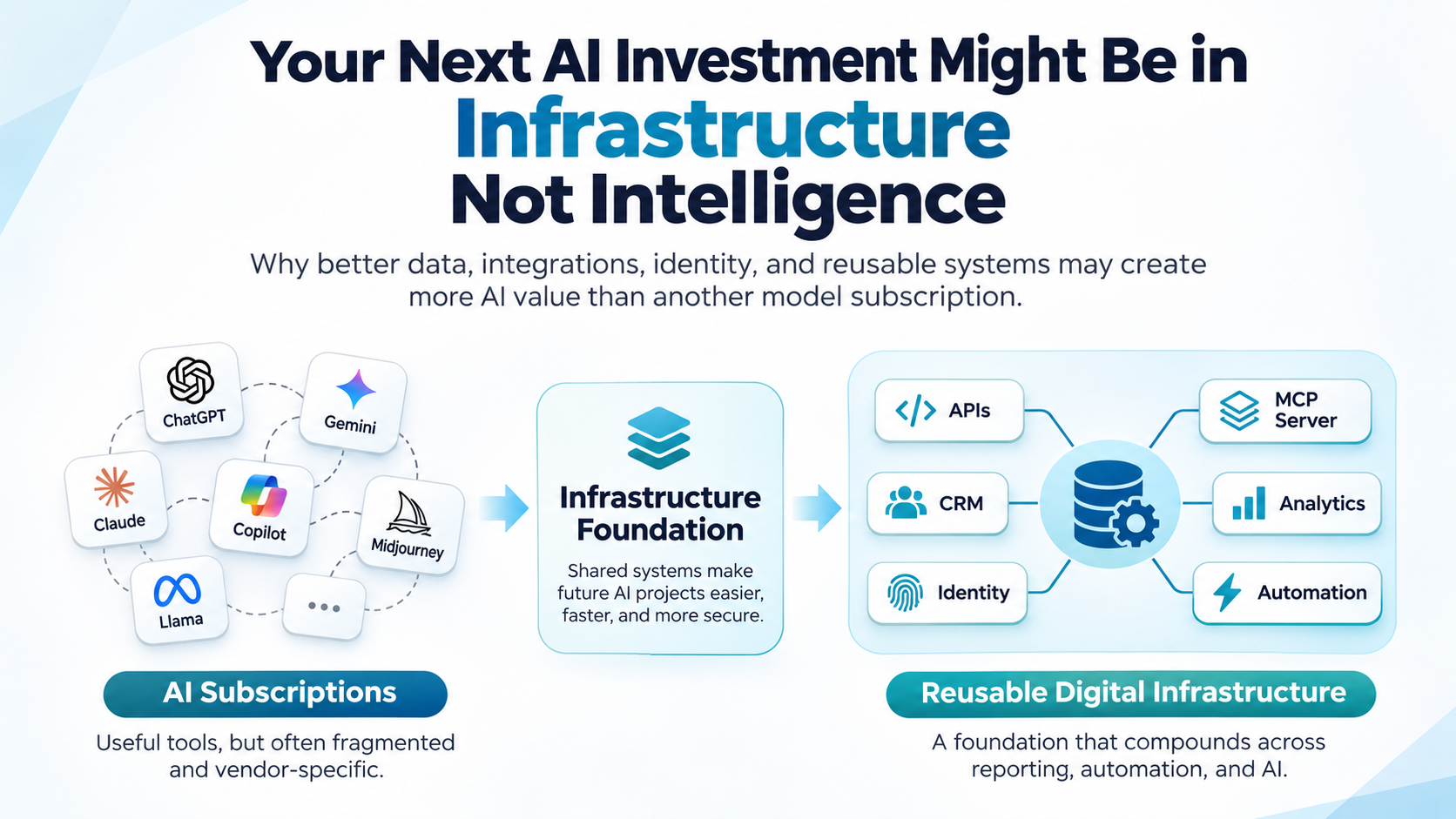
Your Next AI Investment Might Be in Infrastructure, Not Intelligence
Over the past 15 years, businesses have accumulated a considerable number of cloud-based software applications. Different departments have subscribed to different applications to solve different business problems, often with limited consideration for how these applications fit into the organization's overall digital infrastructure.
As a result, many businesses today are dealing with duplicated customer records, fragmented reporting, redundant software subscriptions and a considerable amount of manual work moving information between systems that were supposed to make their staff more productive.
We are potentially going to repeat the same mistakes with AI, except at a much faster pace.
Consider a business that uses five different AI applications for customer service, marketing, sales, reporting and internal document management. Each application may have its own integrations, subscriptions, permissions and access to the same customer information.
What happens when a staff member leaves the organization and several business-critical AI workflows reside within their personal account? What happens when a better AI model becomes available six months later? How much of the work that went into developing these workflows needs to be redone?
As we discussed in our previous article on AI implementation, many of the bottlenecks preventing businesses from benefiting from AI have very little to do with the intelligence of the models themselves.
Your next AI investment might not be in AI at all.
Building Infrastructure That Can Be Reused
One of the principles we believe businesses should consider when investing in technology is whether an investment makes subsequent investments easier, faster or less expensive.
Take marketing reporting. For every FlexHours client, we connect Google Analytics, Google Ads, Google Search Console and Bing Webmaster Tools, consolidate the data into a single database, reconcile it using consistent business rules, and use AI to surface insights on top of that foundation.
That foundation is built once, and it keeps paying off. Add one more connection, to the client's CRM, and the same infrastructure can support:
- Automated monitoring of advertising performance and customer acquisition costs.
- Sales forecasting based on historical lead and revenue data.
- Identification of customer segments that are more profitable than others.
- AI-assisted recommendations for allocating marketing budgets.
- Automated notifications when business performance deviates from expectations.
Building that foundation takes more effort than subscribing to an AI reporting tool. But each capability built on top of it costs a fraction of starting from scratch, and the business keeps control of its data, business logic and integrations, whichever AI model or application it uses next.
This is how technology investments compound rather than simply accumulate.
The same principle applies to how AI connects to your systems. The Model Context Protocol (MCP) gives compatible AI applications and agents a standard way to work with external data, software and tools. Instead of building a separate CRM integration for every AI application, a business can build one MCP server that lets multiple AI tools work with its CRM through a common interface, within the permissions you set.
Infrastructure Does Not Have to Mean Enterprise-Sized Budgets
By infrastructure, we don't necessarily mean purchasing expensive servers, investing in GPUs or hosting your own AI models. Nor does modernizing your digital infrastructure necessarily require a large capital investment or a multiyear digital transformation project.
For many small and medium-sized businesses, the opportunities are considerably more straightforward. They may involve replacing an outdated application that does not have an API, consolidating customer information into a single CRM, establishing centralized authentication or automating a process that currently involves exporting spreadsheets from multiple systems.
None of these activities are particularly exciting from an AI perspective. However, they could make dozens of subsequent AI and automation implementations possible.
Before investing in another AI subscription, businesses may want to examine whether some of their existing technology investments are actually preventing them from taking advantage of newer technologies.
Practical Steps: How to Prepare Your Digital Infrastructure for AI
Where should you start? On Monday morning, pick a recurring business process that requires your staff to manually retrieve information from multiple systems. Document which systems are involved, how much time the process consumes and what prevents it from being automated. This will give you a practical starting point for identifying which infrastructure investments could create immediate business value.
From there, we recommend prioritizing the following:
- Inventory your existing applications and their integration capabilities. Document which applications your business is paying for, what information they contain, who manages them and how they are connected to other systems. Include AI applications and workflows that staff members have independently set up. When evaluating existing or prospective software, look beyond features and pricing to consider API availability, webhooks, data export capabilities and authentication standards. A relatively inexpensive application could become very expensive in the long run if it prevents your business from automating important processes.
- Establish a single source of truth for important business information. Determine which systems should be authoritative for customer records, sales information, financial data and other important business information. Note that this does not necessarily mean consolidating everything into one database. It means establishing where information should come from and how discrepancies between systems should be resolved. If your marketing department and accounting department cannot agree on how much revenue a particular campaign generated, introducing AI will not necessarily solve the problem. In fact, it could amplify it.
- Build reusable, vendor-independent integrations. If you are investing in connecting two systems, consider whether that connection could support other business processes in the future. Evaluate technologies such as APIs and MCP servers that allow multiple applications and AI agents to make use of the same underlying integrations. Where practical, separate your business data, integrations and business logic from the AI models you use. What happens if your AI provider jacks up its token prices? What happens if it sunsets a model and its replacement behaves differently? These changes should not require you to rebuild an entire business application.
- Modernize your identity and access management. Historically, businesses have primarily been concerned with managing the identities and permissions of their employees. Increasingly, they will also need to manage the identities and permissions of their AI agents. An AI agent responsible for generating financial reports should not necessarily have permission to modify financial records. Similarly, an AI agent responsible for monitoring advertising performance should not automatically have permission to change advertising budgets. Establish dedicated service identities for autonomous workflows where supported, assign narrowly scoped permissions, maintain an inventory of active agents and establish processes for reviewing and revoking their access. Do not rely on instructions in an AI prompt to enforce security restrictions that should be enforced by the underlying systems.
- Keep as much of your business logic deterministic as possible. Just because AI can perform a task does not mean it should. Retrieving data, calculating customer acquisition costs, validating records and applying established business rules can often be accomplished more reliably and economically using conventional software. Use AI where its ability to interpret information, deal with ambiguity and exercise judgement creates additional value. Our belief is that most of the code underpinning business-critical AI applications should still be deterministic wherever practical. This makes applications easier to test, less expensive to operate and less dependent on the behaviour of any particular AI model.
- Establish testing, monitoring and recovery capabilities. If AI is going to become part of your business operations, it needs to be managed with the same discipline as other business-critical software. Establish separate testing environments where practical, maintain logs of automated activities and develop mechanisms for identifying failures. What happens if an API changes, an AI provider experiences an outage or an automation stops working without anyone noticing? Businesses should also periodically test whether their AI applications continue to produce acceptable results when the underlying models are updated or replaced.
Building Capabilities That Compound
Given the rate at which AI technology is evolving, it is difficult to predict which AI models, applications or platforms will be the most relevant three to five years from now.
However, we can be reasonably confident that businesses with reliable data, well-integrated software systems, secure digital infrastructure and clearly defined business processes will be in a better position to take advantage of these technologies.
This is also why we recommend that businesses allocate a portion of their ongoing technology budgets towards continuous modernization, rather than treating every infrastructure improvement or automation initiative as a separate project.
When prioritizing these investments, consider not only the immediate business value they create but also the subsequent opportunities they enable. An integration that saves five hours of staff time per month may not appear particularly compelling on its own. However, if it also makes five other automation initiatives possible at a fraction of what they would otherwise cost, the economics look considerably different.
There is also an opportunity cost associated with maintaining outdated digital infrastructure. Every month that a business spends manually reconciling information, working around software limitations or dealing with fragmented systems is a month in which it could have been developing new capabilities instead.
As AI matures, we believe the competitive advantage will increasingly come from how quickly a business can go from identifying a technological opportunity to implementing it.
How Smartt Can Help
One of the challenges with modernizing digital infrastructure is that the work rarely falls neatly into a single discipline. Improving a business process may require changes to IT infrastructure, software integrations, website functionality, data analytics and cybersecurity, sometimes all within the same initiative.
This is one of the reasons we developed Smartt's FlexHours service. Rather than having to maintain separate budgets and engage different vendors for each of these disciplines, businesses can access a multidisciplinary team and allocate their resources towards whichever technological bottlenecks or opportunities are most important at any given time.
We can help businesses inventory their existing digital infrastructure, identify modernization opportunities, develop reusable integrations and MCP servers, improve their security posture and incrementally implement AI and automation solutions.
You don't need to modernize your entire digital infrastructure before you start benefiting from AI. In many cases, the better approach is to identify a specific business opportunity, implement a solution and build the underlying infrastructure in a manner that makes subsequent initiatives easier and less expensive.
Contact Smartt to learn how our FlexHours service can help your business modernize its digital infrastructure, reduce technological bottlenecks and build capabilities that compound over time.


