 Branding
 Digital Marketing
 Web & App Dev
 IT Services
AI Advertising Is Expanding. Are Businesses Ready to Measure It?
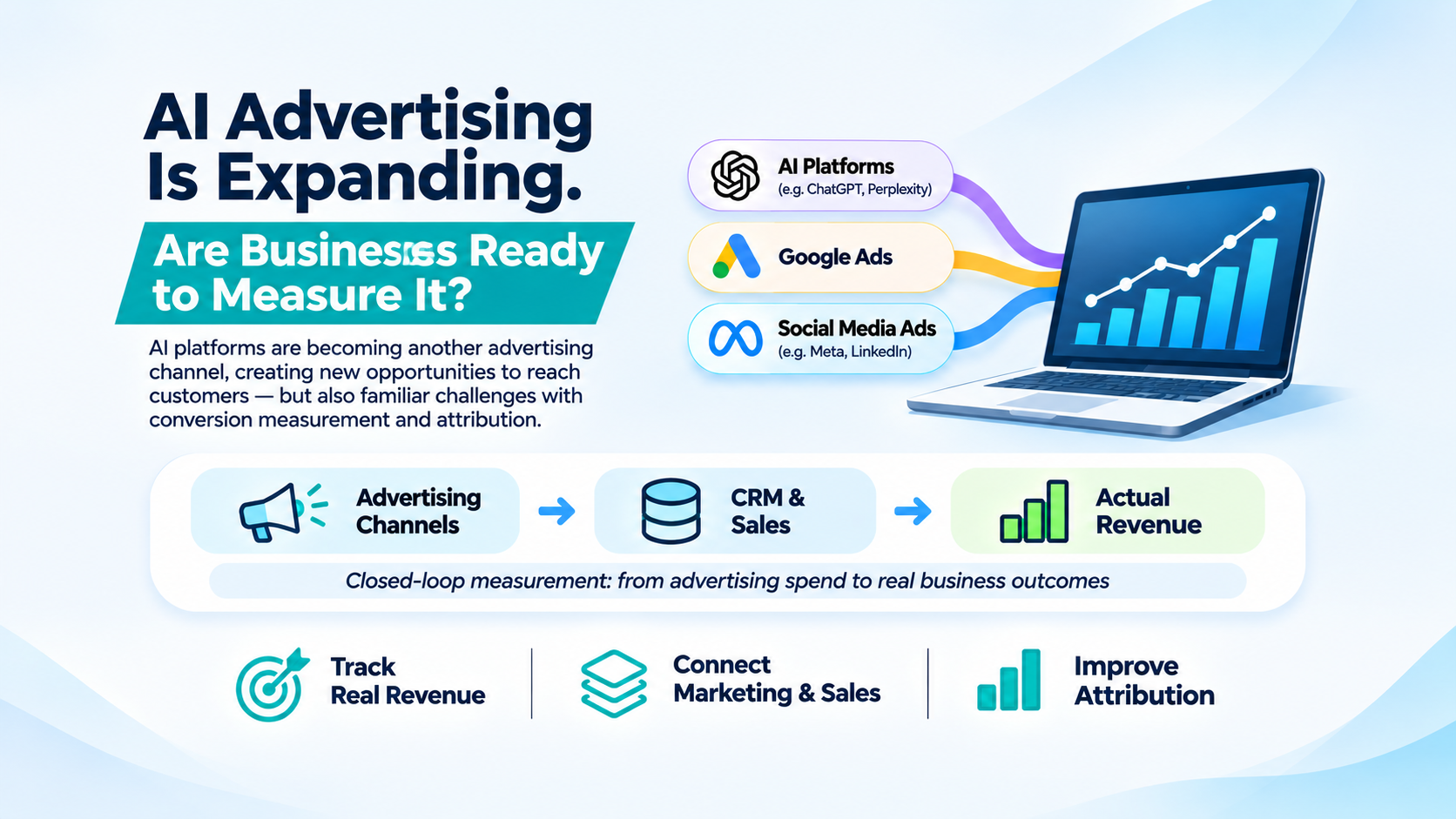
Digital advertising has evolved considerably over the past two decades, from banner advertisements and keyword-based search campaigns to social media advertising and increasingly automated campaign management.
Now, AI platforms are becoming another advertising channel. As more people use AI assistants to research and make purchasing decisions, businesses will have new opportunities to reach potential customers. However, this also reintroduces some very old advertising problems:
Age-Old Problem #1: Conversion Measurement
Advertising platforms have become increasingly sophisticated at reporting impressions, clicks, engagement, and conversions. However, the information reported by these platforms does not necessarily reflect the results that matter most to a business.
For example, one campaign might generate 100 leads but only five customers, while another generates 30 leads and 15 customers. The second campaign may also attract customers who spend more money.
If the business only measures cost per lead, it could end up increasing its budget for the less profitable campaign. These problems already exist across Google Ads, social media, and other advertising channels. Introducing AI advertising makes consistent measurement even more important, particularly when different platforms may claim credit for the same customer.
Age-Old Problem #2: Attribution
Traditional search advertising often begins with a relatively specific query. Someone searches for a product or service, reviews the results, and decides whether to visit an advertiser's website.
AI conversations can be more complex. A potential customer might begin by asking about a business problem, explore several possible solutions, compare alternatives, and gradually narrow down their choices. Advertising presented during this process may influence a purchasing decision long before the customer is ready to contact a business.
For example, someone might discover a company through an AI assistant, return several days later through Google Search, and eventually contact the company directly. Depending on how conversions are tracked, the AI platform may receive no credit, while Google or direct traffic receives the conversion.
This is not a new attribution problem, but AI introduces another potential touchpoint that businesses need to understand.
Solution: "Closed-Loop" Reporting and Multi-Channel Attribution
The solution is to connect advertising data with actual business results. Rather than relying on what Google, social media, or AI advertising platforms report, businesses should track what happens after someone becomes a lead. Did they become a customer? How much revenue did they generate?
Closed-loop reporting connects advertising platforms with CRM and sales data, while multi-channel attribution helps businesses understand how different channels contribute to a sale. The goal is not perfect attribution, which may never be possible, but a clearer picture of which advertising investments are actually generating business.
Practical Steps: How to Set It Up
Before investing heavily in AI advertising, businesses should make sure they can measure the effectiveness of their existing channels in a closed-loop system:
- Track leads beyond the initial conversion. Connect website forms, phone calls, and other inquiries to your CRM so you can determine which leads become estimates, opportunities, and actual sales.
- Preserve the original marketing source. Capture UTM parameters, click identifiers where available, and landing page information when a lead is created. Avoid overwriting the original source when the customer returns through another channel.
- Measure customer acquisition cost and revenue. Cost per lead is useful, but cost per acquired customer and revenue generated provide a much better picture of marketing performance. Where possible, compare return on ad spend using actual sales rather than estimated conversion values.
- Compare results across platforms. Google Ads, social media, and emerging AI advertising platforms may use different attribution models. Consolidating their data with CRM and sales records can help identify discrepancies and avoid double-counting conversions.
- Monitor lead quality and conversion rates. Look beyond the number of leads. Which campaigns generate qualified opportunities? Which sources produce customers with higher average transaction values? Where are potential customers being lost during the sales process?
- Test your conversion tracking. Make sure website forms, phone calls, and other inquiries are being recorded correctly. Test the entire process from the initial visit to the CRM. Missing or duplicate conversions can lead to poor advertising decisions.
- Send actual sales data back to advertising platforms. Where supported, import qualified leads and completed sales from your CRM into Google Ads and other platforms. This helps their algorithms optimize for customers who generate revenue rather than simply generating more leads.
- Track AI referrals and customer discovery. Make sure your analytics can identify visitors arriving from AI platforms such as ChatGPT and Perplexity. Consider asking customers how they first heard about your business, since not every AI-influenced visit will appear as an AI referral in analytics.
- Review results regularly and adjust budgets. Build a reporting dashboard that brings together advertising costs, leads, conversions, and actual revenue. Review the results monthly to identify which channels are generating customers and where budgets should be adjusted.
- Account for longer sales cycles. A lead generated this month may not become a customer until several weeks or months later. Keep updating CRM records and conversion data as opportunities progress so that advertising performance reflects actual sales.
Smartt helps businesses connect their advertising platforms, websites, analytics, and CRM systems to measure performance beyond clicks and leads. Contact us to learn how better marketing attribution and business intelligence can help you make more informed decisions about your advertising investments.


