 Branding
 Digital Marketing
 Web & App Dev
 IT Services
Your YouTube Videos May Be More Valuable to AI Search Than You Think
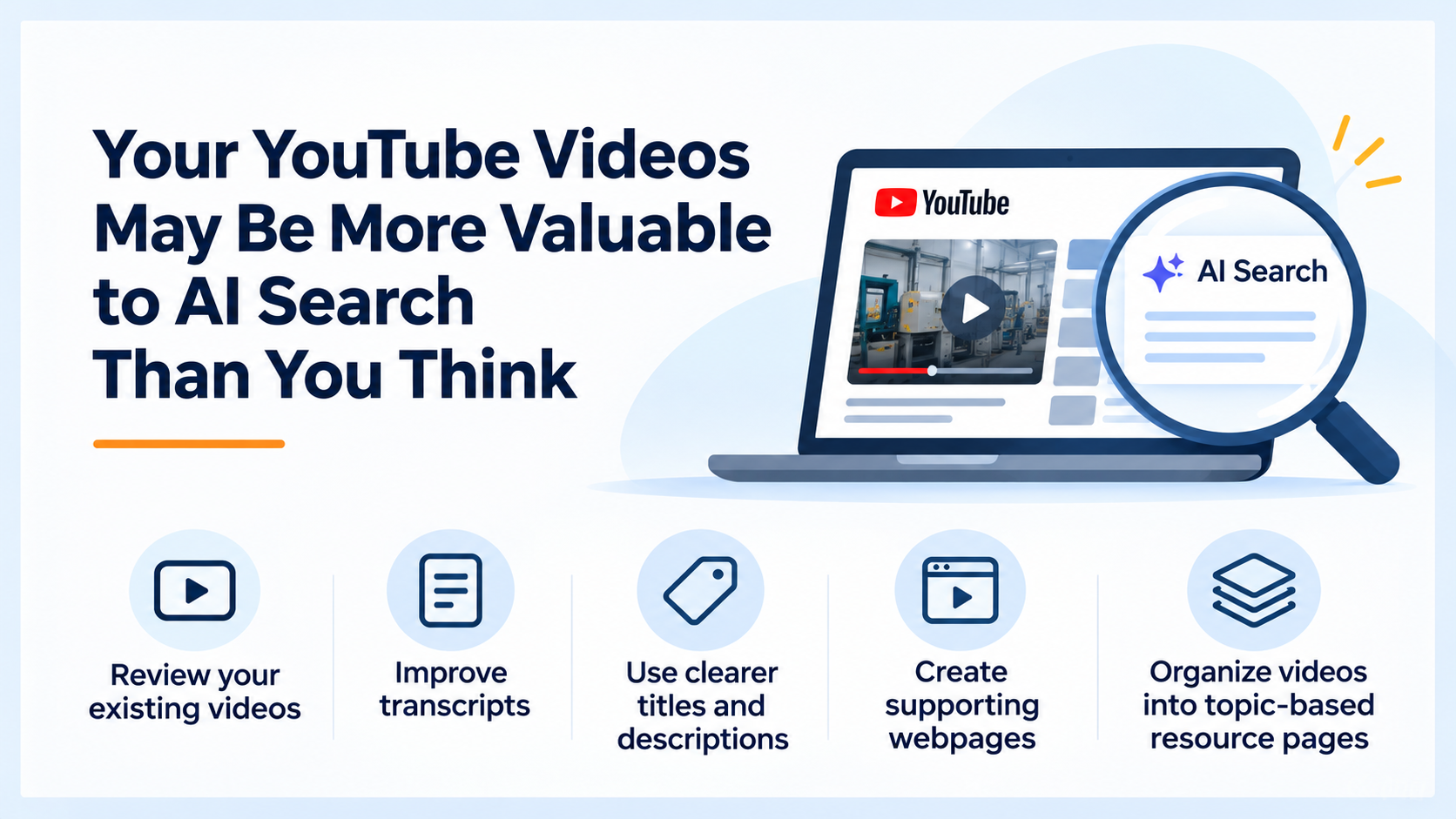
Many businesses have spent years producing videos for YouTube, including product demonstrations, webinars, interviews, tutorials, and customer testimonials. Some of these videos may have received thousands of views, while others attracted relatively little attention after they were published.
However, with the growing use of AI-powered search, these videos may be more valuable than businesses realize.
The reason is simple. A video that answers a specific customer question can contain useful information that isn't available anywhere else on a company's website. And as search engines and AI assistants become better at discovering and interpreting video content, businesses have another opportunity to make that information accessible.
Before investing in another round of content production, it may be worth looking at what you already have.
AI Search Is Creating New Opportunities for Existing Content
Traditional search engine optimization has focused on webpages, keywords, links, and technical website structure. YouTube videos have also appeared in Google search results for years, particularly for searches involving tutorials, demonstrations, and product comparisons.
AI-powered search adds another dimension.
Search engines and AI assistants can use video transcripts, titles, descriptions, and related webpages to identify information that helps answer a user's question.
For example, imagine a manufacturer that published a 45-minute technical webinar two years ago. Buried within that webinar is a detailed explanation of how its equipment solves a particular customer problem.
The webinar may have received only a few hundred views, but the explanation could still be useful to someone researching that exact problem today.
The challenge is making that information easy to find and understand.
A descriptive title, accurate transcript, useful video description, and supporting webpage can all help search systems identify what the video covers. Publishing the transcript or a well-organized written summary on your website also creates another opportunity for that information to appear in search results and potentially be referenced by AI-powered answers.
This doesn't guarantee that an AI assistant will cite your content. However, it gives search systems more accessible information to work with.
Five Practical Ways to Get More Value From Your Existing Videos
Rather than treating YouTube as a separate marketing channel, businesses should consider how their existing video libraries can support their broader content and SEO strategies.
Here are five practical things you can do.
1. Review your existing videos for useful information.
Start by looking through your YouTube library, particularly webinars, product demonstrations, tutorials, and expert interviews.
Don't judge the value of a video based solely on its view count. A video with 200 views that answers a highly specific technical question may be more useful to a prospective customer than a general promotional video with 20,000 views.
Look for videos that address common customer questions, explain technical concepts, compare products, or demonstrate how something works.
2. Review and improve your video transcripts.
YouTube can automatically generate captions for many videos, but these aren't always accurate, particularly when they contain technical terminology, product names, or industry-specific language.
Review the transcripts of your most valuable videos and correct important errors.
You can also use AI tools to help turn transcripts into structured written content. A 30-minute webinar might contain enough information for several articles, FAQs, or product explanations.
The important thing is to preserve the accuracy of the original information rather than simply generating more content for the sake of publishing.
3. Improve your video titles, descriptions, and chapters.
Many companies upload videos with titles such as "Product Webinar - March 2024" or "Company Presentation."
These titles don't tell potential viewers or search systems much about the information covered.
Instead, use descriptive titles that explain the topic or problem being addressed.
For example, "How RFID Asset Tracking Helps Hospitals Reduce Equipment Search Time" is more useful than "Healthcare Technology Webinar."
Descriptions should summarize the main topics, include relevant product or resource links, and explain what viewers will learn.
For longer videos, add timestamped chapters so people can navigate directly to the sections that interest them.
4. Create supporting webpages for your most valuable videos.
Don't rely entirely on YouTube to make your content discoverable.
For important videos, consider creating a dedicated webpage containing the embedded video, a written summary, relevant headings, and either an edited transcript or the key questions answered.
This gives visitors the option to watch or read the content while creating a useful resource on your own website.
It also gives search engines a conventional webpage to crawl and potentially reference. (Note that this supporting content should be organized, accurate, and useful to your audience.)
5. Organize related videos into topic-based resource pages.
If your business has produced multiple videos about a particular product, service, or industry challenge, consider bringing them together into a comprehensive resource page.
For example, a company selling industrial equipment might have separate videos covering installation, maintenance, troubleshooting, and product comparisons.
Instead of leaving these scattered across YouTube, they could become part of a central equipment resource hub containing videos, articles, technical documents, and frequently asked questions.
This makes it easier for customers to research a topic and gives search engines a clearer understanding of how the content relates.
Smartt helps businesses develop integrated SEO, content, and digital marketing strategies that make better use of their existing digital assets. Contact us to explore how your content can support search visibility and lead generation.


