 Branding
 Digital Marketing
 Web & App Dev
 IT Services
Your Company May Soon Have More AI Agents Than Employees. Who Will Manage Them?
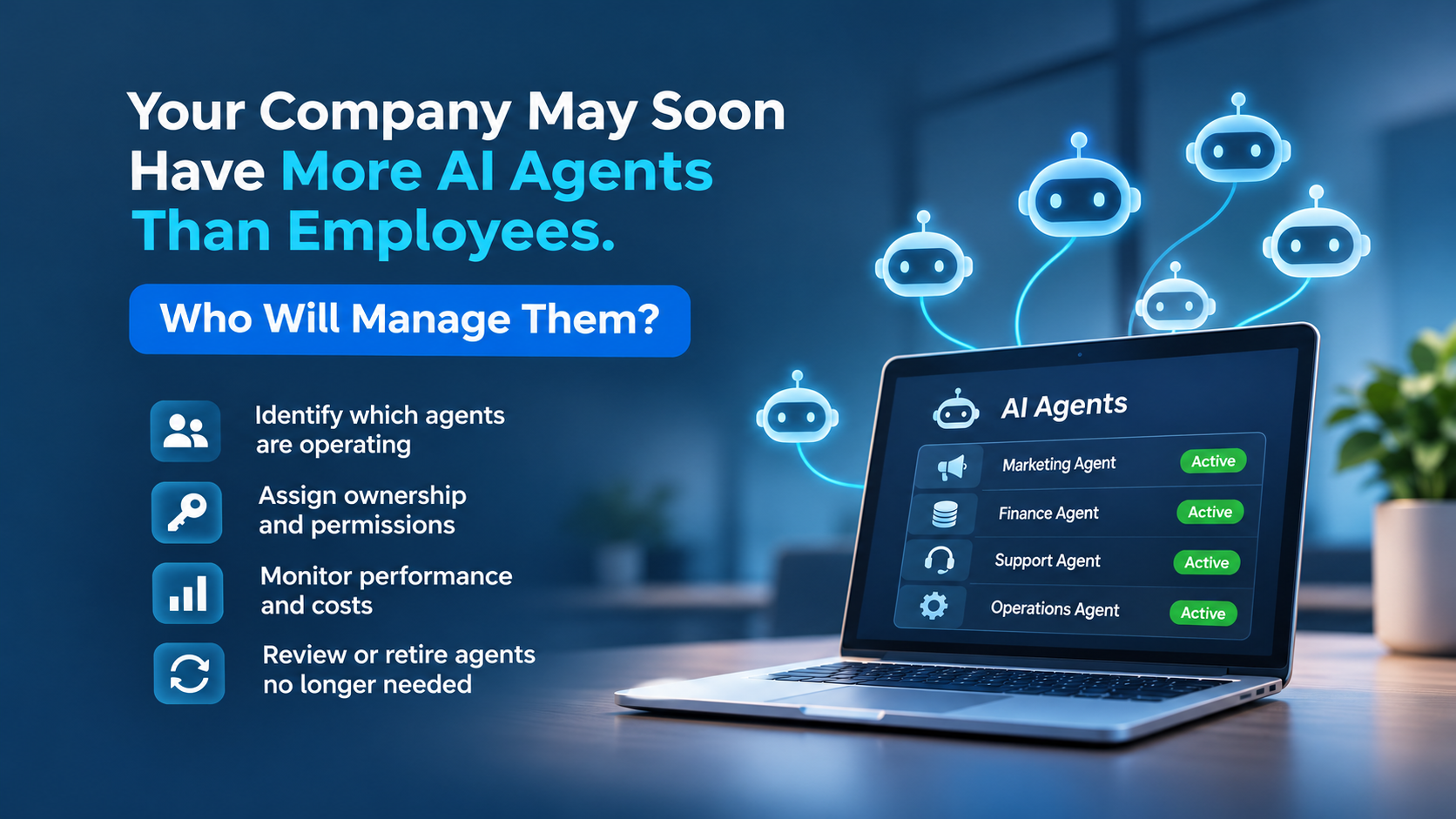
Last week, a client called us for help because things were breaking in their workflows after they let go of a marketing manager. It turned out there were unauthorized agents that stopped working when their accounts were disabled upon their departure.
This is quickly become a challenge for businesses. In November 2026, Microsoft reported that more than 50 million agents had been registered in its Agent 365 platform, illustrating how quickly AI agent management is becoming an important category of enterprise technology.
An AI agent can perform tasks, access information, interact with applications, and execute workflows on behalf of a business. And unlike traditional software, agents may be able to make decisions about how to complete an assigned task, be it marketing, finance, or customer support.
As the number of agents increases, the challenge will shift from figuring out what AI can do to understanding who is responsible for what it does.
AI Agents Need Identities and Owners
The most visible problem is relatively straightforward. Per the example above, if an employee leaves a company, IT normally disables their accounts and removes their access to business systems. But what happens when an AI agent is no longer needed, its creator leaves the organization, or its original purpose changes? (Here is an extreme example: we recently met someone at a conference with over 180 agents running on his work computer.)
An agent may still have access to files, databases, APIs, and other services unless somebody is responsible for managing its lifecycle. So when that person leaves, what happens? Do things break? Or even worse, will they become backdoors in the future?
The Problem Goes Beyond Security
Security is an important consideration, but it is only one part of managing AI agents.
Businesses also need to understand whether agents are performing their tasks correctly, how much they cost to operate, and whether the benefits justify their ongoing use.
An automated workflow that saves an employee a few minutes may not be valuable if it consumes substantial resources (we have seen plenty examples of incorrect setups that wastes tokens), produces unreliable information (which are then sent to vendors customers), or requires significant time to monitor and correct.
There is also the question of accountability. When an agent makes an incorrect change, sends the wrong information to a customer, or creates an unexpected operational problem, someone needs to be responsible for identifying and resolving the issue.
These are not entirely new challenges. Businesses already deal with similar questions when managing software integrations, automated processes, and third-party services. AI agents make them more important because the systems involved may operate with greater independence and less oversight.
AI Management Will Become Part of IT Management
For most businesses, the answer will not be to create an entirely separate department responsible for AI agents. Instead, agent management will increasingly become part of existing IT governance, security, and operational processes.
Our stance is clear: every business using AI agents should be able to identify which agents are operating, what they are intended to do, who owns them, and what systems they can access.
Organizations should begin developing a basic inventory of their agents, assigning ownership, defining permissions, monitoring performance, and establishing procedures for reviewing or retiring agents that are no longer needed.
Smartt combines managed IT, software development, and AI automation expertise to help businesses implement technology that is secure, reliable, and aligned with their operational needs. Contact us to discuss your AI strategy.


