 Branding
 Digital Marketing
 Web & App Dev
 IT Services
The Case for Canadian-Hosted Infrastructure: What You Gain and What You Give Up
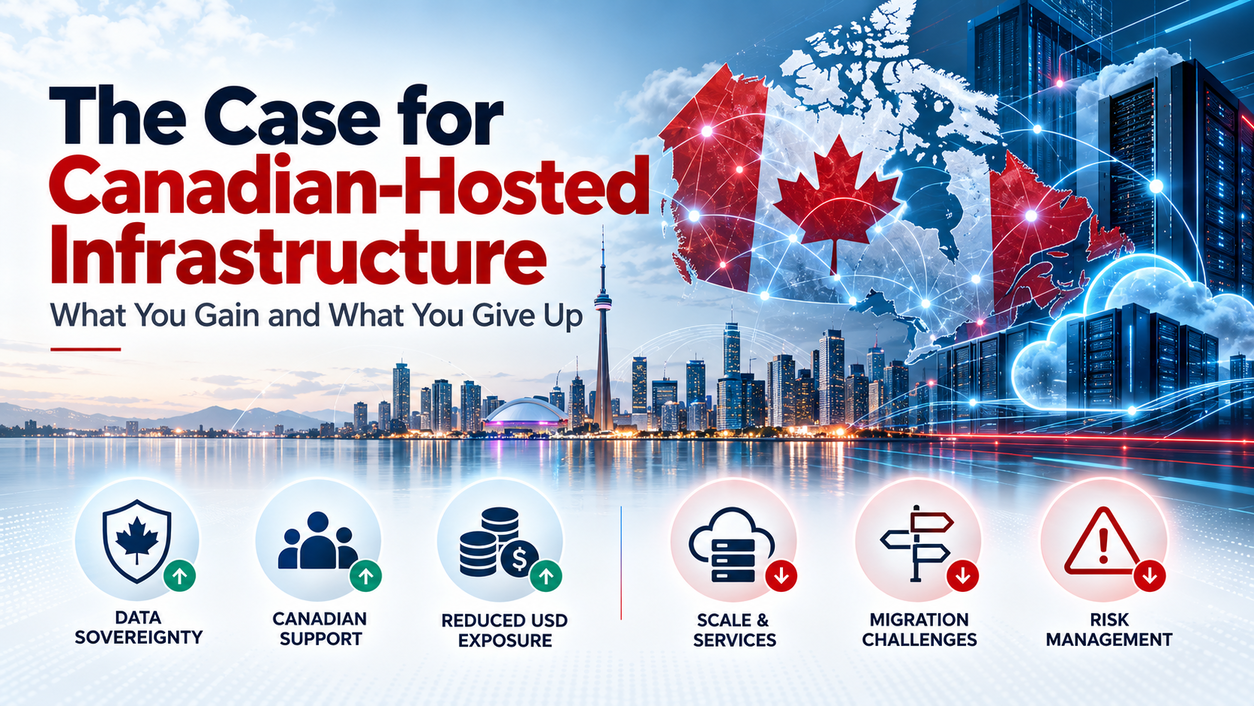
For years, most Canadian businesses made their hosting and infrastructure decisions based on a relatively straightforward set of criteria: cost, performance, reliability, and available features. If a US-based cloud provider offered the best combination, there was usually little reason to look elsewhere.
That calculation is changing.
With the ongoing trade tensions between Canada and the United States, tariffs, uncertainty around cross-border economic relations, and growing concerns about data sovereignty, Canadian businesses are starting to reconsider how dependent they should be on American technology providers.
This is not just about patriotism or supporting Canadian businesses, but understanding the risks of relying on infrastructure, services, and technology platforms that are ultimately controlled by companies and governments outside Canada.
At the same time, moving everything to Canadian providers is not necessarily the best answer either. American hyperscale providers such as Amazon Web Services (AWS), Microsoft Azure, and Google Cloud offer capabilities, economies of scale, and ecosystems that smaller Canadian providers cannot always match.
The question is no longer simply whether Canadian hosting is better. It is where Canadian-hosted infrastructure makes business sense, what risks it helps reduce, and what compromises you may need to accept.
1. What You Gain from Canadian-Hosted Infrastructure
Greater Control Over Data and Jurisdiction
One of the strongest arguments for Canadian-hosted infrastructure is greater control over where your data is stored, processed, and accessed.
However, there is an important distinction between data residency and data sovereignty. Just because your data is stored in a Canadian data centre does not necessarily mean it is beyond the reach of foreign governments.
For example, a US-owned cloud provider operating data centres in Canada may still be subject to American legal requirements, including the CLOUD Act. Canadian data residency alone does not eliminate that exposure. Working with a Canadian-owned and operated infrastructure provider can help reduce some of these jurisdictional risks, particularly when the provider's ownership, operations, personnel, and contractual arrangements are also based in Canada.
This does not guarantee complete protection from foreign legal requests, but it can give businesses greater control over their infrastructure and a clearer understanding of which legal jurisdictions apply.
Regulatory Compliance and Industry Requirements
Canadian businesses operating in healthcare, financial services, legal services, and other regulated industries often have additional requirements around privacy, security, record retention, and access to sensitive information.
Canadian hosting can make it easier to satisfy certain contractual, regulatory, or client-imposed data residency requirements.
(Note that there is no universal Canadian law requiring businesses to keep all its data within Canada. Requirements vary by industry, province, type of information, and contractual obligations. Businesses should evaluate their actual compliance requirements rather than assume that Canadian hosting is either mandatory or automatically compliant.)
Reduced Exposure to US Trade and Political Risk
The Canada-US trade relationship has become less predictable, and the current trade war has highlighted how quickly policies affecting cross-border business can change.
Although tariffs on physical goods do not automatically apply to cloud hosting or digital services, Canadian businesses still face potential exposure to currency fluctuations, pricing changes, regulatory restrictions, and other policy decisions affecting American technology providers.
For example, a Canadian company paying for its infrastructure in US dollars may see its costs increase simply because the Canadian dollar weakens. Changes to cross-border service arrangements or foreign government policies could introduce additional uncertainty. Canadian-hosted infrastructure, particularly when purchased from Canadian-owned providers with Canadian-dollar pricing, can help reduce some of these exposures.
Although it does not make a business immune to international trade disputes, since Canadian providers may still depend on American hardware, software, and suppliers, it can reduce the number of external factors that directly affect your operations.
Greater Confidence for Canadian Clients
For some Canadian customers, knowing that their information is stored and managed in Canada is becoming an increasingly important consideration.
This is particularly relevant for organizations handling confidential business information, personal data, financial records, or sensitive client information.
Being able to demonstrate Canadian data residency, Canadian operational control, and appropriate security safeguards may help strengthen client confidence and differentiate your business from competitors.
Note that hosting data in Canada is not the same as guaranteeing that the data never leaves Canada, especially when backups, monitoring systems, support personnel, or third-party integrations may operate internationally.
Canadian Support and Accountability
Another potential advantage is working with a provider that understands Canadian business practices, regulations, and operating environments.
For Canadian SMBs, having access to a local technical team that can provide direct support and take responsibility for infrastructure issues can be more valuable than having access to hundreds of cloud services they may never use.
This advantage depends on the provider, of course. Canadian ownership alone does not guarantee better support, but smaller providers such as Smartt may offer more direct relationships and greater flexibility than large international platforms.
2. What You Give Up by Choosing Canadian Providers
Scale and Available Services
The biggest disadvantage of moving away from major cloud providers is the difference in scale.
AWS, Microsoft Azure, and Google Cloud have invested enormous amounts in their infrastructure, global networks, developer tools, security capabilities, and specialized services.
Many Canadian infrastructure providers offer excellent virtual servers, dedicated hosting, storage, networking, and managed services. However, they may not provide the same breadth of advanced analytics, AI services, serverless computing, managed databases, or globally distributed infrastructure.
If your business relies heavily on these capabilities, replacing them may be expensive or complicated.
Potentially Higher Costs
Canadian infrastructure is not necessarily more expensive, but it depends on what you are comparing. For straightforward workloads such as virtual machines, website hosting, backups, and dedicated servers, Canadian providers can be competitive, especially when pricing is in Canadian dollars.
For more complex environments, hyperscale providers may offer better economies of scale, flexible consumption models, and integrated services that reduce development and administration costs. The important comparison is the total cost of ownership, including licensing, support, management, data transfer, security, and migration expenses, rather than simply comparing the monthly price of a server. We’d always be happy to provide to provide a custom quote that takes the above into consideration.
Migration and Integration Challenges
Many businesses have built their applications and operational processes around services provided by Microsoft, Amazon, Google, and other large technology companies.
Moving those workloads to an independent Canadian provider may require changes to application architecture, authentication, databases, automation, monitoring, and backup systems. There is also the issue of vendor lock-in. Moving from a US provider to a Canadian provider does not automatically eliminate dependency if the new environment relies on proprietary technologies that are difficult to replace.
Fewer Geographic Redundancy Options
Canada has a smaller concentration of cloud infrastructure than the United States, and independent Canadian providers may have fewer data centres and geographic regions available.
For businesses that require high availability, disaster recovery, and geographic redundancy, this can limit their options.
It is still possible to design highly resilient infrastructure entirely within Canada, but the provider's facilities, network diversity, backup arrangements, and disaster recovery capabilities need to be evaluated carefully.
A Smaller Technology Ecosystem
One of the less obvious advantages of major cloud platforms is the enormous ecosystem surrounding them.
There are thousands of integrations, consultants, developers, training resources, and third-party products designed specifically for AWS, Azure, and Google Cloud.
Smaller Canadian providers may offer excellent core infrastructure but have fewer ready-made integrations and specialized resources. For businesses with complex applications or significant internal development requirements, this difference can have a real impact on implementation costs and ongoing maintenance.
3. The Canadian Hosting Question Is Really About Managing Dependencies
The current trade tensions have made many Canadian businesses more aware of how dependent they are on American suppliers. However, replacing every American technology product with a Canadian alternative is neither realistic nor necessarily beneficial.
Consider how much of a typical business technology environment depends on US companies. Microsoft 365 may handle email and collaboration, AWS or Azure may host applications, Google may provide analytics and advertising, and numerous American SaaS platforms may support sales, finance, customer service, and operations.
Even when the servers are physically located in Canada, the underlying software, hardware, licensing, and support arrangements may still involve American companies.
This means Canadian hosting should be viewed as part of a broader technology risk management strategy rather than a complete solution to foreign dependency.
A more useful approach is to identify which systems are critical to your business, understand where the dependencies exist, and determine what would happen if pricing, access, contractual terms, or service availability changed unexpectedly.
For example, could you move your website or application to another provider without rebuilding it? Are your backups stored independently of your primary hosting provider? Can you export your business data in a usable format? Do you have a disaster recovery plan that works if your main provider becomes unavailable?
These questions matter regardless of whether your infrastructure is hosted in Canada or the United States.
4. A Practical Middle Ground for Canadian Businesses
For most Canadian SMBs, the best strategy is to make more deliberate decisions about where different workloads belong.
A practical approach might include:
- Keep sensitive and regulated data in Canada where appropriate. Evaluate Canadian-owned infrastructure providers for systems where data residency, jurisdiction, confidentiality, and operational control are especially important.
- Continue using hyperscale cloud services where they provide clear advantages. If your applications require specialized AWS, Azure, or Google Cloud capabilities, there may be little benefit in replacing them simply to avoid an American provider. Where appropriate, use Canadian regions and review the provider's contractual, security, and data handling arrangements.
- Reduce unnecessary vendor lock-in. Where practical, use open standards, portable applications, documented configurations, and backup systems that make it easier to change providers in the future.
- Build redundancy that does not depend entirely on one provider. A secondary backup or disaster recovery environment with an independent provider can reduce the impact of outages, account issues, or other service disruptions.
- Evaluate your exposure to currency and pricing changes. Canadian-dollar contracts and predictable infrastructure pricing may be valuable, particularly for businesses operating on tighter margins.
- Review infrastructure decisions as part of your technology roadmap. Hosting decisions should not be made once and forgotten. Changes in business requirements, technology capabilities, regulations, and international trade conditions can all affect whether your current arrangements still make sense.
The objective is not to eliminate every foreign dependency. It is to understand which dependencies create meaningful business risks and reduce them where the benefits justify the cost.
5. How Smartt Helps
At Smartt, we help Canadian businesses evaluate their hosting and infrastructure options based on cost, performance, security, compliance, and operational risk. That includes identifying where Canadian-hosted infrastructure makes sense, where existing cloud services should be retained, and where unnecessary dependencies can be reduced.
Through our FlexHours program, we can help assess your current environment, develop a practical infrastructure roadmap, and implement the hosting, backup, security, and disaster recovery solutions that best fit your business. Note that our FlexHours programs do come with hosting and connectivity along with software license and hardware discounts, so we may be able to give you a 1-stop shop approach to your migration planning and execution. Please get in touch if you’re interested in learning more!


