 Branding
 Digital Marketing
 Web & App Dev
 IT Services
Why the Best IT Leaders Are Starting to Think Like Product Managers
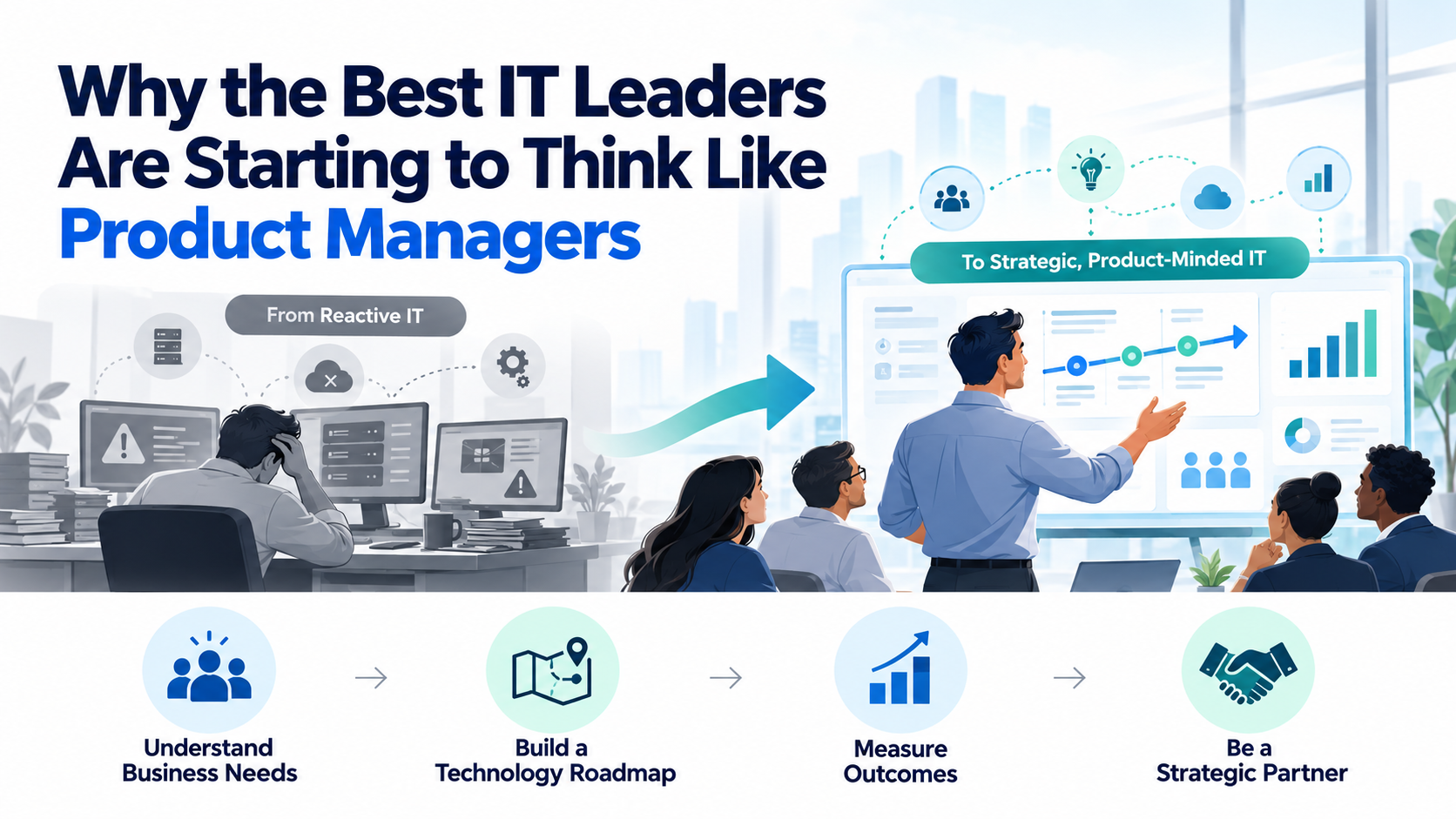
Traditionally, the role of IT in a business has been to keep systems running, manage infrastructure, supports employees, and resolve technical problems when they arise. While these responsibilities are still important, we think businesses have started expecting more from their IT leaders in the age of AI and automation.
One way to approach this is to think more like a product manager.
A good product manager doesn't simply wait for customers to request features and then build them. They try to understand what customers are trying to accomplish, identify opportunities for improvement, prioritize investments, and measure whether the product is actually delivering value. At Smartt, we think IT leaders can applying the same thinking to the technology they manage within their organizations. (And we are here to help them!)
Here are four areas where this approach can make a difference.
1. Understand What the Business Actually Needs
One of the problems with traditional IT support is that most interactions begin when someone submits a request or reports a problem. As a result, IT teams often spend their time responding to symptoms without necessarily understanding the underlying business needs. This extends out to the Managed Service Providers (like Smartt) that they contract out to.
For example, a sales manager might request a new reporting tool when the real problem is that customer information is scattered across several systems. Whilst building another report might satisfy the immediate request, it doesn't necessarily solve the larger problem. Rather than simply asking what technology someone needs, IT leaders should be asking what they're trying to accomplish, what is slowing them down, and whether there's a better way to achieve the desired outcome.
This requires regular conversations with people across sales, marketing, finance, operations, and other departments like to what a Product Manager does, and not just when something breaks. But if the company does this properly, it will bring the kind of forward-looking multi-departmental synergy that will reap great value in the long run.
2. Build a Technology Roadmap Around Business Priorities
Most businesses have more technology projects they would like to pursue than they have the time, budget, or resources to complete.
Without a roadmap, priorities tend to be determined by whoever complains the loudest, whichever system is causing the most immediate problems, or whatever new technology happens to attract management's attention. A product manager approaches this differently by evaluating opportunities based on their potential impact, the resources required, and how they support longer-term objectives. IT leaders should do the same.
For example, automating a process that consumes several hours of employee time every day might deliver more value than upgrading a system simply because a newer version is available.
This way the technology roadmap prioritizes high value investments over other opportunities.
3. Measure Business Outcomes, Not Just IT Performance
Traditional IT metrics such as uptime, ticket resolution times, and system availability are important, but they don't tell the complete story. A company could have excellent IT support metrics while its employees continue wasting hours on manual processes, working with disconnected systems, or struggling to access the information they need.
IT leaders should also be measuring what their technology investments are accomplishing for the business. Are employees becoming more productive? Are salespeople spending less time on administrative work? Are customers receiving better service? Are systems providing management with better information for making decisions?
For example, reporting that an automation was successfully deployed is less meaningful than demonstrating that it eliminated 20 hours of manual work each month.
The difference is between measuring what IT has done and measuring what IT has helped the business achieve.
4. Become a Strategic Partner Rather Than an Order Taker
One of the biggest changes in this approach is that IT leaders need to become more involved in business decisions rather than waiting for technology-related instructions. This is particularly important now that AI is making it easier for employees and departments to experiment with technology independently. A marketing manager might build an automation, a salesperson might create a reporting dashboard, or an operations manager might use AI to develop an internal application without involving IT.
We don't think IT leaders should automatically discourage these initiatives. (In fact, in many cases, this kind of experimentation is exactly what businesses should be encouraging, in a secure and controlled manner.) However, someone still needs to consider how these solutions fit together, whether they are secure, whether they can scale, and whether they are actually the best use of the organization's resources.
Instead of becoming the department that tells everyone what they cannot do, IT should help people accomplish what they want more effectively, while making sure individual initiatives contribute to a broader technology strategy.
The Bigger Opportunity
We think the distinction between IT management and business improvement will become increasingly blurred over the next few years. As AI and automation make technology easier to create and deploy, the competitive advantage won't necessarily come from having the largest IT department or the most sophisticated tools. It will come from understanding where technology can create the most value and having the judgment to implement it properly.
That's why I believe the best IT leaders will increasingly need the skills of product managers. They need to understand users, evaluate opportunities, prioritize investments, coordinate different stakeholders, and take responsibility for business outcomes rather than simply technical deliverables.
Instead of just keeping the technology working, they will help make sure technology is continually helping the business work better.
How Smartt Helps
Smartt helps growing businesses move beyond reactive IT support toward more strategic technology management. Through our FlexHours model, we combine managed IT, digital services, automation, and technology advisory to help businesses prioritize opportunities, develop practical roadmaps, and turn technology investments into measurable results.