 Branding
 Digital Marketing
 Web & App Dev
 IT Services
How Canadian SMBs Should Respond to US Technology Dependency Risk
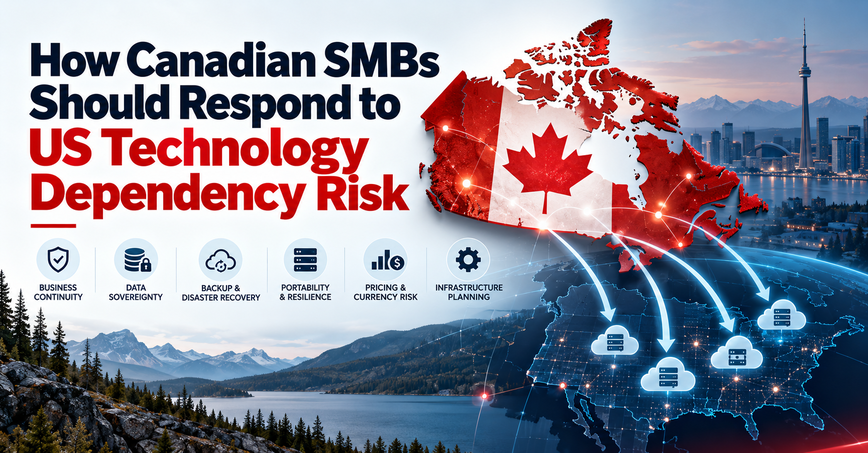
For years, Canadian businesses have relied heavily on American technology companies to run their operations. Microsoft provides email, productivity software, and collaboration tools. Google handles advertising, analytics, and cloud services. Amazon Web Services hosts applications and infrastructure, while countless other American software companies provide everything from accounting and CRM systems to cybersecurity and business automation. (And in recent years, OpenAI/ChatGPT and Anthropic/Claude power AI.)
For the most part, this arrangement has worked well. Canadian businesses have benefited from access to some of the most advanced technology platforms in the world without having to develop or maintain those capabilities themselves. However, the ongoing trade tensions between Canada and the United States have introduced new questions about how dependent Canadian businesses should be on American technology providers.
The current trade war has demonstrated how quickly cross-border business conditions can change. Tariffs, changing trade policies, currency fluctuations, and uncertainty surrounding the broader Canada-US relationship have encouraged businesses to take a closer look at their exposure to foreign suppliers.
Note: This does not mean American technology platforms are suddenly unreliable or that Canadian businesses should stop using them. Technology dependency just deserves more attention as part of business continuity planning as a potential risk. You want to understand where your dependencies exist, what could go wrong, and what you can reasonably do to reduce the risks.
1. Understand What Technology Dependency Actually Means
Technology dependency is not simply a question of which country your software provider is based in, but also how much control your business has over the systems it relies on and what happens when something changes outside your control.
There are several types of risk Canadian businesses should consider.
a) Pricing and Currency Risk
Many American technology companies charge Canadian customers in US dollars, which means the actual cost can fluctuate with exchange rates.
A software subscription that costs US$1,000 per month may become significantly more expensive in Canadian dollars even if the vendor never changes its pricing. (And they do – we have seen some SaaS providers rise price by a few times over the past two years.)
For businesses with dozens of software subscriptions, cloud services, and infrastructure contracts, these changes can add up.
b) Government Policy and Regulatory Risk
Technology companies operate within legal and regulatory environments that can change.
US export controls, sanctions, restrictions on technology transfers, and other government policies can affect which products and services companies are permitted to provide and to whom. For example some frontier models are already only available to certain approved companies.
This becomes particularly important for organizations that depend on specialized technology, sensitive data, or services that are difficult to replace. You don’t want to incorporate a stack that may get ripped out.
c) Business Continuity and Vendor Risk
Technology dependency problem can become geopolitical. A cloud provider can experience a major outage during acts of war, as we have seen. A software company can discontinue a product, change its pricing model, eliminate a feature (all the time with some AI platforms), or be acquired by another company with subsequent price hikes.
If your business depends entirely on that platform, you may have little choice but to accept the changes. (This is especially problematic when a system has become deeply integrated into your operations and moving away from it would require significant time, money, or redevelopment.)
d) Data Sovereignty and Privacy Risk
Canadian businesses also need to understand where their data is stored, who can access it, and which legal jurisdictions apply.
For example, storing information in a Canadian data centre operated by an American company does not necessarily eliminate exposure to American legal requirements, including the US CLOUD Act.
At the same time, using a Canadian-owned provider does not automatically guarantee that data is protected from every foreign jurisdiction, particularly if the provider relies on international subcontractors, support teams, or infrastructure.
The important distinction is between data residency, data ownership, legal jurisdiction, and operational control. (These are related issues, but they ot the same thing.)
e) Geopolitical and Trade Risk
The ongoing Canada-US trade dispute has made the risks associated with international dependencies more visible.
Although tariffs on physical goods do not automatically apply to software subscriptions or cloud services, trade disputes can create indirect consequences through hardware costs, exchange rates, procurement decisions, supply chains, and changes in vendor relationships.
For Canadian businesses, the concern is that relying heavily on foreign technology can potentially create risks that are difficult to predict and largely outside their control. For example, what happens if you rely on a frontier AI model and then it’s taken away?
2. Why Replacing All Your American Technology Is Not a Realistic Strategy
It is easy to suggest that Canadian businesses should simply switch to Canadian technology providers, but the reality is considerably more complicated. Microsoft, Google, Amazon, and other major American technology companies have become deeply embedded in how Canadian businesses operate.
Their platforms are often connected ecosystems involving authentication, security, databases, integrations, automation, reporting, and business processes.
For example, replacing Microsoft 365 is not simply a matter of finding another email provider. A business may also depend on SharePoint, Teams, OneDrive, Entra ID, Intune, Power Automate, and dozens of third-party applications integrated with those services. Moving away from that environment could require months if not years of rebuilding workflows, retraining employees and migrating data.
The same applies to businesses that have developed applications around AWS, Azure, or Google Cloud. There are also legitimate advantages to using large technology providers. Their scale, security investments, global infrastructure, specialized services, and extensive partner ecosystems can provide capabilities that smaller alternatives may struggle to match.
For most Canadian SMBs, abandoning these platforms would introduce more cost and operational risk than it would eliminate. A more practical strategy is to reduce unnecessary dependencies while continuing to use technology that provides clear business value.
3. Start by Identifying Your Most Critical Technology Dependencies
Before evaluating alternatives, understand which systems you cannot operate without. A useful starting point is to identify the five or ten systems that would cause the greatest disruption if they became unavailable.
For many SMBs, this might include email and collaboration, accounting software, CRM, website hosting, file storage, identity management, and industry-specific business applications.
For each critical system, consider the following questions:
- What happens if the service becomes unavailable? Determine how long your business could operate without the system and what the financial or operational consequences would be.
- Can you access and export your data? Understand whether you can retrieve your information in a usable format and how difficult it would be to move it elsewhere.
- How difficult would it be to replace the provider? Some systems can be migrated relatively easily, while others may require months of planning and redevelopment.
- Where is the data stored and who controls it? Review the provider's hosting arrangements, ownership, legal jurisdiction, subcontractors, and data handling practices.
- What alternatives are available? Identify whether another provider could realistically support the same business requirements and what switching would involve.
(Obviously, the purpose of this exercise is not to create a list of American software that needs to be replaced, but to identify where your business has concentrated too much operational risk.)
4. Reduce Your Dependency Without Rebuilding Everything
Once you understand where the risks exist, there are several practical steps you can take without undertaking a major technology migration.
a) Maintain Independent Backups of Critical Business Data
One of the most effective ways to reduce dependency is to maintain backups that are not entirely controlled by the same provider hosting your production systems. For example, if your business relies on Microsoft 365, consider maintaining independent backups of Exchange Online, SharePoint, and OneDrive data.
Similarly, websites, databases, and business applications should have backup arrangements that allow recovery even if the original hosting provider is unavailable. Note: A backup is only useful if it can actually be restored, so recovery testing should also be part of the process.
b) Make Data Portability a Requirement
Before adopting a new platform, understand how your business would retrieve its information if it needed to leave. Some providers offer straightforward exports using common file formats and documented APIs. Others make it difficult to extract data or preserve relationships between records.
Data portability should be considered during software selection rather than discovered when a migration becomes necessary. Where practical, favour open standards, documented integrations, and applications that do not unnecessarily lock your business into proprietary systems.
c) Diversify Where It Makes Business Sense
Not every system needs to be provided by a different company. In fact, excessive diversification can increase complexity, create security gaps, and make technology management more expensive.
However, there are situations where using an independent provider can improve resilience. For example, a business might retain Microsoft 365 for collaboration while using a separate provider for backup and disaster recovery. It might host its public website independently of its primary business applications or maintain secondary infrastructure with another provider.
This way, you avoid situations where one vendor failure can take down multiple critical business functions at the same time.
d) Evaluate Canadian Alternatives During Normal Technology Refresh Cycles
Rather than replacing working systems simply because their vendors are American, consider Canadian alternatives when contracts expire, new requirements emerge, or existing platforms no longer meet business needs. In some cases, you can even create simple platforms that are customized to your needs instead of relying on SaaS subscriptions. (This is something we are seeing more and more of amongst clients.)
e) Review Your Software and Infrastructure Contracts
Businesses should understand their exposure to pricing changes, currency fluctuations, service discontinuation, and changes to contractual terms. Where possible, Canadian-dollar billing, predictable renewal terms, clear data export provisions, and documented service commitments can help reduce uncertainty.
For business-critical systems, it is also worth reviewing termination provisions, data retention policies, service-level agreements, and the assistance available if you need to migrate.
5. Build Technology Independence Into Your Long-Term Roadmap
One of the biggest mistakes businesses make is treating technology risk as something to address only when a problem occurs.
By the time a major vendor announces a product discontinuation, increases prices substantially, or experiences a prolonged outage, your options may already be limited.
A better approach is to include technology dependency and portability in your ongoing technology roadmap. This means reviewing your critical systems periodically, maintaining current documentation, testing backups, evaluating alternative providers, and making sure new technology investments do not create unnecessary dependencies.
It also means recognizing that the lowest-cost option today is not always the lowest-risk or lowest-cost option over the long term. For example, a proprietary cloud service may allow a business to launch an application quickly and inexpensively, but the long-term cost of moving away from that service should still be considered.
In a nutshell you want to maintain enough control, documentation, and flexibility that your business can adapt when circumstances change.
6. How Smartt Helps
At Smartt, we help Canadian businesses understand their technology dependencies and identify practical ways to reduce operational risk. That includes reviewing critical business systems, hosting arrangements, cybersecurity, backups, disaster recovery, and opportunities to improve data portability and infrastructure resilience.
Through our FlexHours program, we can help assess your existing technology environment, prioritize the risks worth addressing, and implement improvements without requiring a complete overhaul of your systems.
The ongoing Canada-US trade tensions are a useful reminder that business conditions can change quickly, but the underlying principle applies regardless of international politics. Businesses should understand the technology they depend on and maintain enough flexibility to adapt when those dependencies change. Give us a call if you’re interested in a free initial consultation!


