 Branding
 Digital Marketing
 Web & App Dev
 IT Services
When a Third-Party Platform Breaks, Does Your Business Have a Backup Plan?
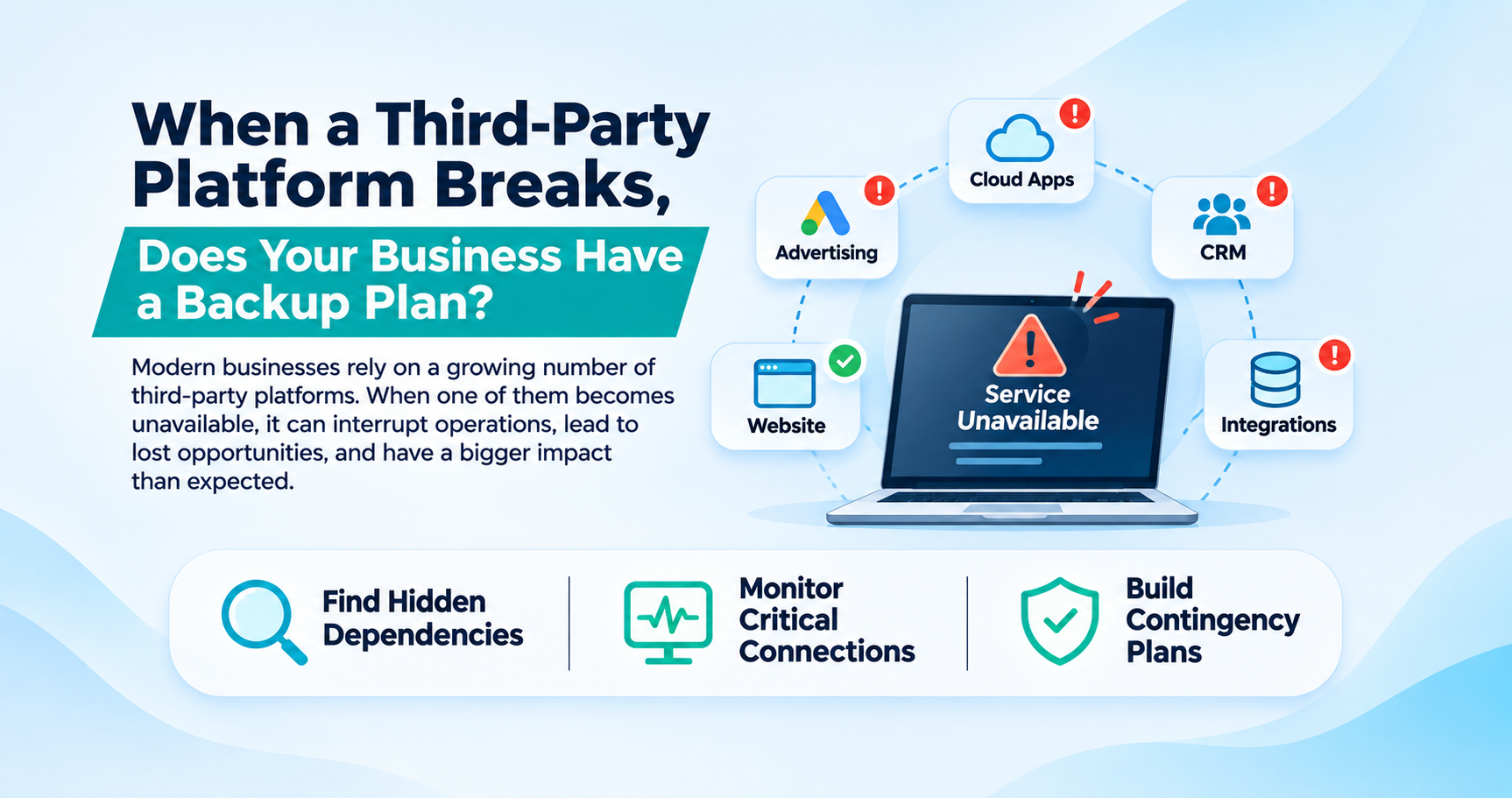
Modern businesses often rely on a growing number of third-party platforms to operate. Aside from the website, there's the CRM, different cloud applications, and advertising platforms or product feeds.
Whilst these systems have made it easier for businesses to access sophisticated technology without building and maintaining everything themselves, they also create dependencies that are not always obvious until something stops working.
For example, on November 6, Google confirmed an issue affecting Merchant Center, its API, and product feeds. The issue ended up lasting 8.5 hours. For businesses that rely on these services to manage product information and support their online advertising activities, disruptions can interfere with important marketing operations.
This highlights a broader question: what happens to your business when a platform you depend on becomes unavailable?
Not Every Dependency Is Immediately Visible
Most businesses understand the impact of their website going offline. Customers may be unable to access information, submit inquiries, or complete purchases.
But what we have been noticing when we audit prospective clients are failures in connected systems that are not as visible if they are not being watched actively, such as:
- A website may remain accessible while its contact forms fail to deliver leads to the CRM. (Or it notifies a person who is no longer working there.)
- An advertising campaign may continue spending money even though conversion tracking has stopped working.
- An integration may silently fail, leaving customer records incomplete or outdated.
In these situations, the business may continue operating without realizing that important information or opportunities are being lost. And because the silent failure goes unnoticed, the damage ends up being greater over time.
Business Continuity Goes Beyond Backups
Many organizations associate business continuity with data backups and disaster recovery. Whilst they are essential, they are only part of the picture. Businesses should also understand which third-party services are critical to their operations and what happens when those services become unavailable.
Remember the Microsoft 365 outage between Nov 12 - 14? Many offices had to basically send their employees home.
And how about if a CRM integration stops working? What if Cloudflare goes down again like it did in 2025? What if the single-sign-on system stops working? What if Apple payments cannot be taken, like on Nov 17?
Being able to identify these important dependencies and establish reasonable contingency plans based on the potential business impact will be critical for businesses.
Monitoring Is Just as Important as Recovery
Another consideration is how quickly problems can be detected. To expand on business continuity, businesses need to monitor more actively, or it may be months before they notice a certain single form stopped sending leads into the CRM.
Monitoring should therefore extend beyond servers and websites to include important business functions. This might involve checking not just whether website forms are submitting successfully, but also whether CRM integrations are processing records, whether conversion tracking is operating correctly, and whether automated workflows are completing as expected.
The more connected a business becomes, the more important it is to monitor the connections between its systems.
Resilience Requires Understanding the Entire Operation
Whilst businesses do not need to control every technology platform they use, they should understand how those platforms affect their operations. By identifying critical dependencies, monitoring important processes, and establishing practical recovery procedures, organizations can reduce the impact of failures that occur outside their direct control.
Smartt combines managed IT, hosting, cybersecurity, development, and digital services to help businesses improve the reliability and resilience of their technology environments. Contact us to review your critical systems and business continuity requirements.


