 Branding
 Digital Marketing
 Web & App Dev
 IT Services
The AI Industry Is Discovering That Implementation Matters More Than Intelligence
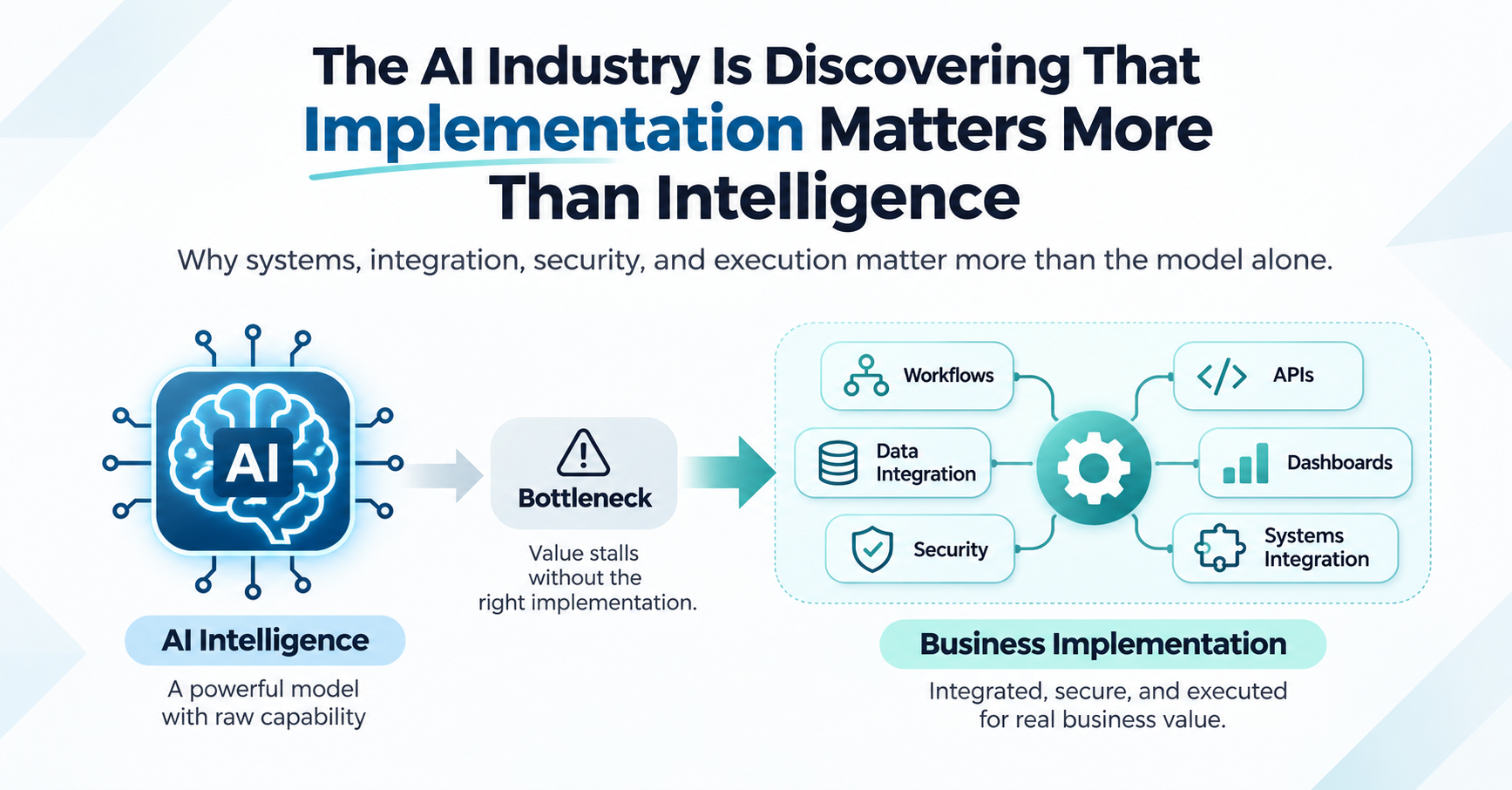
For the past few years, much of the competition in artificial intelligence has centred around which company can develop the most intelligent AI model. Frontier models like Fable are regularly compared based on their reasoning capabilities, coding performance, accuracy and ability to perform increasingly complex tasks. Open-weight models are also benchmarked against them.
However, an interesting development is taking place in the AI industry. As Barron's reported on November 27, both OpenAI and Anthropic are increasingly investing in engineers who work directly with businesses to help them implement AI solutions.
For companies that have invested billions of dollars in developing artificial intelligence, this is an interesting development. They are recognizing that making intelligence available to businesses and making it useful to businesses are two very different things.
In fact, many of the bottlenecks preventing businesses from benefiting from AI today have very little to do with the intelligence of the AI models themselves.
The Gap Between AI Adoption and AI Implementation
Talk to almost any staff member today and they are likely already using AI to write emails, summarize documents, conduct research or assist with various administrative tasks, whether they admit it or not.
While these activities can improve individual productivity, they do not necessarily improve organizational productivity. In some cases, they are simply creating another layer of shadow IT that businesses will eventually have to deal with.
Consider a business that wants to use AI to improve the effectiveness of its marketing and sales activities. To do this properly, it may need to:
- Retrieve advertising costs and performance data from multiple advertising platforms.
- Retrieve website traffic and conversion data from its analytics platforms.
- Retrieve lead, estimate and sales information from its CRM.
- Reconcile the information across these systems to determine which marketing activities are actually generating revenue.
- Identify opportunities to improve performance and communicate them to the appropriate staff members.
None of these activities are particularly difficult for today's more capable AI models to assist with. However, there is a considerable amount of work involved in making the information available to AI in a reliable, secure and repeatable manner.
Who is going to connect the systems? What happens when the data from two systems doesn't match? How do we determine whether the AI's conclusions are accurate? Who is responsible for maintaining the integrations when one of the software vendors changes its API?
These are all implementation challenges where upgrading to a more intelligent AI model will not necessarily solve any of them. In fact, most of these should actually be done by deterministic code. (Our Flexhours program covers this – we have been doing more and more of this kind of work for clients!)
AI Is Increasing the Value of Systems Integration
Remember all the systems integration companies from the 1990s and early 2000s, many of which eventually evolved into Managed Service Providers (MSPs)?
Interestingly, systems integration may become more important than ever. Historically, businesses invested in systems integration to reduce manual data entry, improve reporting and automate relatively predictable tasks. AI considerably expands what businesses can accomplish once these systems are connected.
For example, instead of simply generating a monthly sales report, a business could develop a system that proactively identifies changes in customer demand, detects deteriorating sales performance, investigates potential causes and recommends corrective actions.
However, we also need to recognize that we are introducing another layer of complexity into our digital infrastructure. There are more things that can break, more systems that need to be maintained, more security considerations and potentially more consequential mistakes when things go wrong.
This is why AI implementation is increasingly a multidisciplinary exercise involving business strategy, software development, data analytics, IT infrastructure and cybersecurity. (Note: This is why FlexHours is perfect.) These disciplines, which many businesses have historically managed separately, are becoming increasingly interdependent.
Practical Steps: How Should Businesses Approach AI Implementation?
Rather than starting with the question of which AI model to use or which AI software to purchase, we recommend starting with the following:
- Identify your business bottlenecks. Look at where your staff spend a disproportionate amount of time gathering information, reconciling data, performing repetitive tasks or waiting for decisions to be made. These are often better candidates for AI implementation than activities that are simply easy to automate. Start by benchmarking how much time or money these bottlenecks currently cost your business.
- Conduct an inventory of your digital systems. Identify where your business information resides, which systems are already integrated and which systems offer APIs. You may discover that some of your biggest obstacles to AI implementation are actually legacy software, fragmented data or manual processes that should have been modernized years ago.
- Determine what actually needs AI. Not everything needs to be done with AI. If a conventional software script can reliably retrieve, calculate or reconcile information, it may be cheaper and more reliable to do it that way. Use AI where its ability to interpret information, recognize patterns or deal with ambiguity creates additional value. In many cases, the best solution will be a combination of conventional software and AI.
- Establish security and operational guardrails. Determine what information AI systems should have access to, what actions they can perform independently and what actions require human approval. For example, there is a considerable difference between allowing AI to recommend changes to an advertising campaign and allowing it to independently spend thousands of dollars. Start with read-only access wherever practical and expand permissions as the system demonstrates reliability.
- Build small implementations using real business data. Rather than embarking on a large-scale AI transformation project, select a specific business problem and develop a working solution. Test it against historical data, compare its output against work performed by your staff and identify where it fails. A successful demonstration is not the same as a system that can reliably operate every day.
- Measure the business outcomes. If you are automating a reporting process, measure how much staff time is actually saved. If you are using AI to qualify sales leads, measure whether it improves sales conversion rates. If you are using AI to handle customer inquiries, measure whether it improves response times and customer satisfaction. Include the cost of operating, supervising and maintaining these systems when evaluating their return on investment.
- Plan for ongoing maintenance and modernization. AI implementations are software systems, not one-time projects. APIs will change, AI models will be replaced, business processes will evolve and new security vulnerabilities will emerge. Establish who is responsible for monitoring these systems, troubleshooting problems and continuously improving them.
The benefit of this approach is that much of the work you do to prepare your business for AI - improving data quality, connecting systems, documenting processes and modernizing infrastructure – will already create business value in its own right.
It also reduces your dependency on any particular AI vendor. As better and more cost-effective models become available, you will be in a better position to take advantage of them without having to rebuild your entire digital infrastructure, especially since most of the integrations will actually be deterministic and not AI dependent.
From Access to Execution
One of the interesting things about AI is that two competing businesses can have access to exactly the same level of artificial intelligence at approximately the same cost, yet derive considerably different business outcomes from it.
One business may simply use AI to write better emails. Another may use the same underlying technology to improve its customer acquisition costs, reduce operational overhead, identify new business opportunities and accelerate decision-making.
The difference is in the quality of their digital infrastructure, the maturity of their business processes and their organizational ability to identify opportunities and execute on them.
As AI models become more intelligent, affordable and interchangeable, we believe the ability to implement new technologies quickly, securely and effectively will become an increasingly important competitive advantage. And that’s why businesses should be investing not “just in AI”, but in their capacity to continuously put new technologies to work.
How Smartt Can Help
Of course, one of the challenges businesses may face is this holistic approach is that the expertise required often spans multiple disciplines. A single initiative may involve software development, systems integration, data analytics, digital marketing, IT infrastructure and cybersecurity. For many small and medium-sized businesses, it is neither practical nor economical to maintain all these capabilities in-house.
This is one of the reasons we developed Smartt's FlexHours service. Rather than having to engage different vendors or scope out a new project every time a technological opportunity arises, through FlexHours, businesses can access a multidisciplinary team and allocate their resources based on their evolving business priorities.
Whether you are looking to automate a business process, integrate disparate software systems, improve your reporting capabilities or prepare your digital infrastructure for AI, we can help you identify, prioritize and implement these opportunities incrementally.
You don't necessarily need a large AI transformation budget to get started. In many cases, the better approach is to solve one business problem at a time while continuously building the digital capabilities of your organization.
Contact Smartt to learn how our FlexHours service can help your business turn technological opportunities into measurable business outcomes.


