 Branding
 Digital Marketing
 Web & App Dev
 IT Services
The Human Firewall in the Age of AI
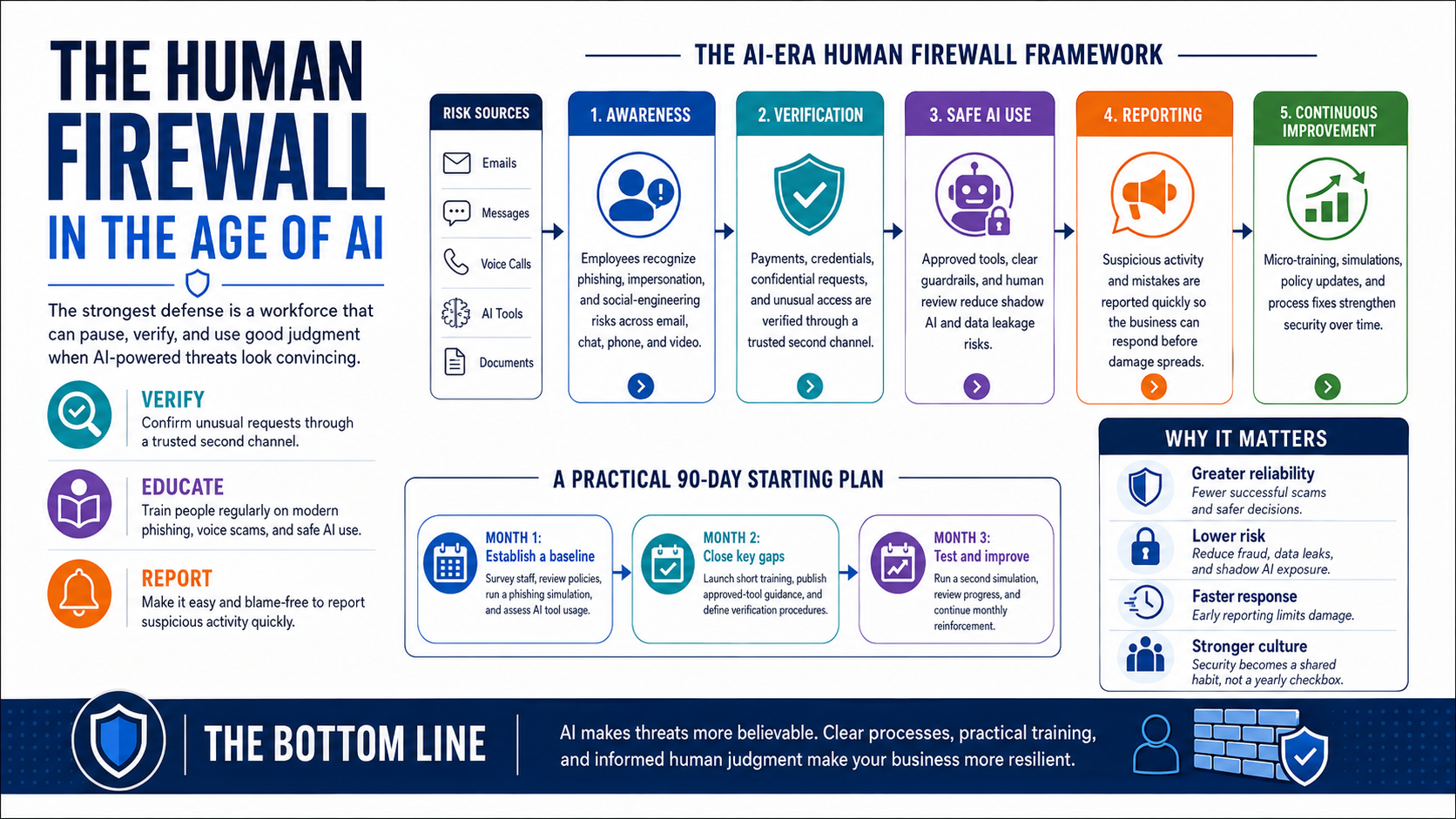
A few years ago, we wrote about how to build a human firewall through practical cybersecurity training, phishing simulations, password management, and a culture in which employees feel comfortable reporting suspicious activity.
Those fundamentals still matter. In fact, they matter more than ever, in an age where the bad guys are harnessing the power of AI to do bad things. Artificial intelligence makes it easier for attackers to create convincing emails, imitate writing styles, clone voices, generate fake images, and personalize scams using information gathered from websites and social media.
The obvious warning signs are disappearing. A phishing email may contain perfect grammar unlike the Nigerian prince emails of yesteryear. A fraudulent message may even sound exactly like your CEO. A voice on the phone may appear to belong to a trusted colleague. Even legitimate AI tools can create new risks when employees enter confidential information or rely on inaccurate answers.
In the age of AI, a human firewall is no longer just a team trained not to click suspicious links. It is a workforce capable of pausing, questioning, verifying, and using good judgment when something does not feel right.
What Is a Human Firewall?
A human firewall is the collective awareness, behaviour, and judgment of everyone in your organization.
It includes employees who recognize phishing attempts, use strong passwords, enable multi-factor authentication, protect sensitive information, and report possible incidents quickly. It also includes managers who follow verification procedures, leaders who model good security habits, and teams that understand how their everyday decisions affect the security of the business.
The idea has always been somewhat light-hearted. People are not literally security appliances, and no employee will identify every threat perfectly. The point is that technology alone cannot protect a company when people are constantly making decisions about emails, files, passwords, payments, cloud platforms, and access to information.
AI makes those decisions more difficult. The human firewall must now protect the business not only from obviously suspicious messages, but from highly believable ones.
AI Has Made Social Engineering More Convincing
Traditional phishing attacks often revealed themselves through poor spelling, awkward language, generic greetings, or strange formatting. Employees were taught to look for those warning signs. But with AI, an attacker can now produce a polished message in seconds, rewrite it in the style of a particular executive, and personalize it with details from LinkedIn, the company website, or a recent announcement. They may even generate a fake website to be part of the charade.
A fraudulent message might reference a real project, name an actual supplier, and arrive at a time when the recipient is expecting an update. Instead of asking the employee to click an obviously suspicious link, it may request a plausible change to payment instructions or ask for a document that appears related to current work.
Generative AI also expands attacks beyond email. Voice cloning can be used to imitate an executive or family member. Deepfake video can make a fraudulent meeting request appear more credible. AI-generated chat messages can maintain a convincing conversation long enough to earn someone’s trust. (Example: romance scams!)
In other words, employees need reliable processes for verifying requests even when everything looks and sounds legitimate. We have to uplevel their judgement.
The New Human Firewall Is Built on Verification
The most important habit in AI-era cybersecurity is not is proactive verification.
Employees should not be expected to determine whether every message, voice recording, or video is authentic based on instinct alone, as the content may be specifically designed to overcome those instincts. Instead, businesses need simple procedures that employees can follow when a request involves money, credentials, confidential information, or unusual access.
For example, a request to change a supplier’s banking information should be confirmed through a known phone number rather than contact details included in the request. An urgent message from an executive asking for a payment should be verified through a second communication channel. A password reset request should follow the company’s established process rather than being approved informally.
These procedures may feel slightly inconvenient, but they remove the pressure from the individual employee. The employee does not need to accuse anyone of fraud or prove that a message is fake. They only need to follow the verification process.
That is how security becomes part of normal business operations rather than a test of individual intuition.
Shadow AI Is Part of the Human Firewall Problem
Employees are also introducing AI-related risks themselves, often without realizing it.
They may paste customer information into a public AI assistant, upload an internal document for summarization, use an unapproved meeting transcription tool, or create an automation connected to company data.
Usually, they are not trying to bypass security, but rather to do work more quickly.
This is similar to the traditional problem of shadow IT, but AI increases the stakes. Employees may not know how a platform stores prompts, whether uploaded information is used to improve the service, or whether the output can be trusted.
A strong human firewall therefore needs to include AI literacy. Employees should know which tools are approved, what information may be entered into them, when human review is required, and how to propose a new use case safely.
Simply banning AI is unlikely to work. The tools are already embedded in search engines, productivity platforms, CRMs, design software, meeting applications, and web browsers. A ban may only make usage less visible.
The safer approach is to give employees clear guardrails and approved alternatives.
Why Traditional Security Training Falls Short
Many cybersecurity training programs still follow a familiar pattern: employees watch a long compliance video once a year, answer a short quiz, and return to work.
This may satisfy a requirement, but it rarely changes behaviour.
Threats evolve too quickly, and the lessons are often too generic. Employees may learn that phishing emails contain spelling mistakes while attackers are already using AI to create polished, highly personalized messages. They may be warned about suspicious links but receive little guidance about voice cloning, fraudulent collaboration requests, or the safe use of AI assistants.
Effective training needs to be shorter, more frequent, and closely connected to the situations employees actually encounter.
A five-minute example based on a realistic payment scam is more useful than an hour of abstract security terminology. A short discussion of what information should never be placed into a public AI tool can prevent more risk than a policy document employees never read.
Training should help people make better decisions, not merely prove that they completed a course.
Five Ways to Strengthen Your Human Firewall
1. Train in Small, Regular Intervals
Security awareness should become an ongoing business practice rather than an annual event.
Short monthly lessons can cover one practical topic at a time, such as identifying a fraudulent payment request, using multi-factor authentication properly, protecting data while travelling, or deciding what can safely be entered into an AI tool.
Frequent reinforcement keeps the information current without overwhelming employees.
2. Simulate Modern Attacks
Phishing simulations remain useful, but they should reflect how current attacks operate.
Tests can include realistic executive impersonation, fake file-sharing notices, credential requests, supplier payment changes, or messages written in the style of an internal colleague.
The purpose should be education rather than embarrassment. Employees who make a mistake should receive immediate, practical guidance. The organization should also review whether its processes made the attack easier to believe.
3. Establish Clear Verification Procedures
Create simple rules for high-risk requests.
Payment changes, password resets, confidential-data requests, and unusual access should require verification through a trusted second channel. Employees should know exactly whom to contact and what steps to follow.
The procedure should still apply when the request appears to come from a senior executive. Authority and urgency are two of the most common tools used in social engineering.
4. Create Practical AI Guidelines
Employees need more than a warning to “be careful with AI.”
Provide a clear list of approved tools and explain what types of information may and may not be entered into them. Set expectations for reviewing AI-generated content and identify situations in which AI should not be used.
Good guidelines should make responsible experimentation easier. Employees should also have a clear way to propose new tools or workflows without having to work around IT.
5. Make Reporting Easy and Blame-Free
Employees will occasionally click the wrong link, enter information into the wrong system, or respond to a convincing request.
The speed of reporting often determines how serious the incident becomes.
People should know how to report a suspected issue immediately and should not fear being punished for an honest mistake. A culture of blame encourages employees to stay quiet, giving attackers more time to act.
A strong human firewall does not require perfect people. It requires people who respond quickly and openly when something goes wrong.
Security Is Everyone’s Responsibility, but Not Everyone’s Burden
It is common to say that cybersecurity is everyone’s responsibility. That is true, but it should not mean placing the entire burden on employees.
Leadership is responsible for establishing sensible processes. IT is responsible for implementing appropriate controls. Managers are responsible for reinforcing good practices. Employees are responsible for following those practices and speaking up when they notice something unusual.
Technology should also support the human firewall. Password managers, multi-factor authentication, email filtering, endpoint protection, access controls, backups, and monitoring all reduce the number of dangerous decisions employees have to make.
The goal is not to choose between people and technology. It is to make them work together.
A Practical 90-Day Starting Plan
During the first month, establish a baseline. Run a security-awareness survey, review existing policies, conduct a realistic phishing simulation, and ask employees how they are currently using AI tools.
In the second month, address the most important gaps. Introduce a short training session, publish a simple approved-tools guide, and create verification procedures for payments, credentials, and confidential requests.
In the third month, run a second simulation, review what has improved, and identify where additional support is needed. Security awareness can then continue through short monthly training, periodic testing, and regular updates as threats and tools change.
The objective is not to create a perfect program in 90 days. It is to establish habits that can improve over time.
Where FlexHours Fits In
Many businesses understand the importance of security awareness but struggle to maintain the program consistently.
Smartt’s FlexHours model can provide ongoing support for phishing simulations, micro-training, AI-use guidelines, password-manager adoption, policy updates, security assessments, and incident-response planning.
Because FlexHours can be allocated across cybersecurity, managed IT, AI governance, cloud platforms, and business processes, the program can evolve with the risks facing the organization.
A phishing simulation may reveal a training need. A review of shadow AI may identify a data-security gap. A recurring verification problem may point to a process that should be redesigned or automated.
Rather than treating each issue as an isolated project, FlexHours provides a way to improve the broader security environment over time.
The Human Firewall Is Really a Culture of Judgment
The age of AI has made the human firewall even more important.
As fraudulent content becomes more convincing, employees cannot rely only on obvious warning signs. They need practical training, clear verification procedures, approved tools, and the confidence to pause when something feels unusual.
The strongest human firewall is a workforce that understands the risks, follows sensible processes, asks questions, and reports problems quickly. AI may help attackers create more believable threats, but it does not remove our ability to respond thoughtfully through proper judgement. The businesses that combine strong technology with informed human judgment will be the ones best prepared for what comes next!