 Branding
 Digital Marketing
 Web & App Dev
 IT Services
The Digital Infrastructure Every Growing Construction Company Needs
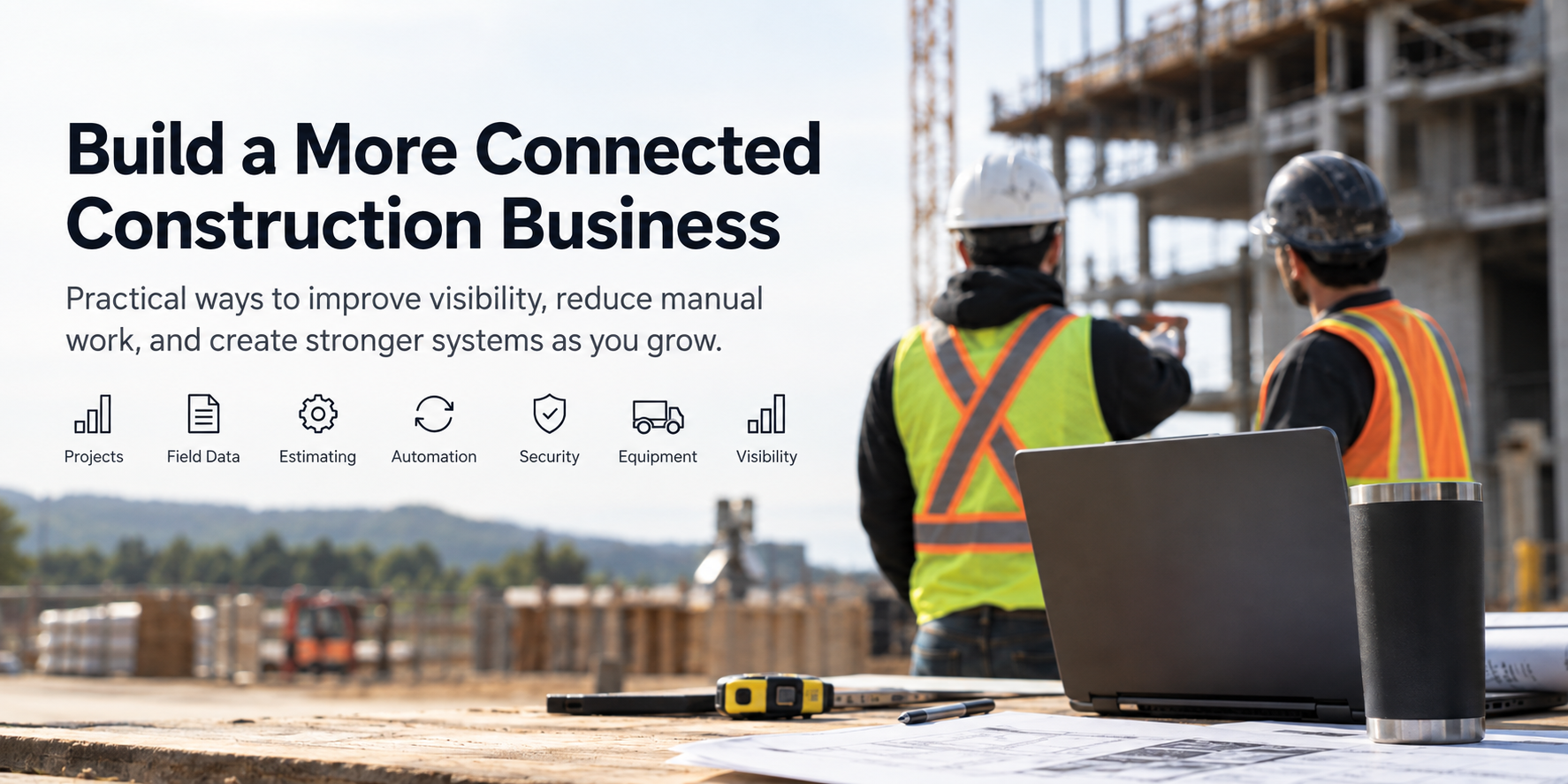
Construction companies are complicated businesses to run.
You have people spread across multiple job sites, equipment moving between locations, subcontractors to coordinate, documents being created constantly, and billing that depends on knowing what is actually happening on each project.
The problem is that many growing construction companies are still managing important parts of the business through spreadsheets, email, paper forms, shared drives, and processes that depend on someone remembering to update something.
That may work when the company is smaller. As the business grows, it becomes harder to control costs, keep information organized, and maintain visibility across projects. Here’re some ways a modern digital infrastructure can make your business easier to operate.
1. Connect Project Management to Job Costing
You should know whether a project is performing as expected while it is still underway. That means being able to compare estimated and actual costs without waiting until the end of the month or rebuilding a spreadsheet manually. At minimum, you should be able to:
- Track estimated versus actual costs by project
- Assign labour hours directly to jobs
- Track materials, subcontractors, and change orders
- Connect project data to progress billing
- See current and projected margins
If management cannot currently tell whether a project is making or losing money “almost in real time”, this should be one of the first areas to fix, as AI can help identify unusual cost changes or summarize project activity if the underlying data is accurate.
2. Standardize Field Documentation
Construction produces a large amount of information every day, including photos, daily logs, safety reports, inspections, RFIs, site instructions, and subcontractor communications.
That information should not be scattered across personal phones, inboxes, and paper.Field teams should be able to capture information from their phones and have it stored against the correct project. A good system should make it easy to answer questions such as:
- What happened on site last Tuesday?
- Where are the photos related to this deficiency?
- Was this instruction documented?
- When was this issue first reported?
- Which RFIs are still outstanding?
Once the information is organized properly, AI can help summarize logs, search project records, turn voice notes into documentation, and draft routine communications. This way, you can keep better records with less administrative work.
3. Use Completed Projects to Improve Estimating
Project estimates should improve as the company completes more projects. You should be able to compare what was estimated with what actually happened and use that information to improve future bids.
However, this requires keeping reliable data on:
- Labour costs and productivity
- Material costs
- Equipment costs
- Subcontractor costs
- Project duration
- Change orders
- Final margins
AI can help review tender documents, summarize specifications, and prepare draft scopes of work.
4. Automate the Gaps Between Systems
Most construction companies already have enough software…which may not work well together. To automate, look for places where employees repeatedly move information between accounting, estimating, payroll, CRM, project management, document storage, and field systems.
Common examples include:
- Creating a project manually after an estimate is approved
- Re-entering change orders into accounting
- Copying information from field forms into another system
- Updating customer information in multiple places
- Exporting reports from one system and importing them into another
- Manually notifying people when a project reaches a certain stage
These are usually good automation opportunities!
These automatons can be deterministic through a standard integration, or they can use AI. Generally, if two systems can exchange structured information directly, a standard integration is usually simpler and more reliable. On the other hand, if something is unstructured needs to be interpreted first before a decision, then AI could be more useful.
5. Treat Cybersecurity as a Financial Control
Construction companies are attractive targets for fraud because they regularly deal with large invoices, deposits, suppliers, subcontractors, and changing payment instructions. An attacker does not need to break into the accounting system. Access to the right email account may be enough to intercept a legitimate payment conversation and change the banking information.
This is why at a minimum, construction companies should:
- Require MFA on email and financial systems
- Confirm banking changes through a second channel
- Verbally verify unusual or large payment instructions
- Remove access quickly when employees or contractors leave
- Keep company devices patched and protected
- Maintain tested backups of critical information
6. Track Equipment Properly
Equipment that sits idle costs money. Equipment that breaks unexpectedly can cost much more.
If your company owns significant equipment or fleet assets, you should be able to see:
- Where each asset is located
- Who is using it
- How much it is being used
- Upcoming maintenance
- Repair history
- Fuel or operating costs
- Utilization by project
Once this information is captured consistently, you can start using it to make better decisions.
You can identify underused equipment, schedule maintenance earlier, and decide whether it makes more sense to buy, rent, move, or retire an asset.
7. Give Management One Clear View of the Business
Management, especially those following systems like EOS want to be able to see a centralized scorecard tat tells them weekly:
- Which projects are performing well
- Which projects are falling behind
- Current and projected margins
- Outstanding change orders
- Upcoming billing milestones
- Accounts receivable
- Equipment utilization
- Major exceptions that require attention
This is also where AI becomes more useful.
Instead of searching through reports, management may eventually be able to ask:
- Which projects had the biggest margin changes this month?
- Which change orders are still waiting for approval?
- What happened on the Richmond project this week?
- Which customers have invoices more than 45 days overdue?
Where Should You Start?
You do not need to replace every system at once.
Start with the places where growth is creating the most friction.
Ask:
- Where are we entering the same information more than once?
- Which spreadsheets have become critical to running the business?
- What information is difficult to find when we need it?
- Where do managers find out about problems too late?
- Which repetitive processes consume the most staff time?
- Which processes create the greatest financial or cybersecurity risk?
Those answers will usually tell you where to start.
Build the Foundation Before Adding More AI
There is no shortage of AI products being marketed to construction companies. And frankly, some will create real value while others will simply add another system to manage. The better approach is to make sure the digital foundation works first. That means reliable data, connected systems, strong cybersecurity, mobile access, and fewer manual processes.Once that foundation is in place, AI and automation can make the business significantly more efficient.
Without it, you are mostly adding new technology on top of existing problems. As we say all the time, it’s People -> Process -> Technology. Skip the first two steps to jump to technology, and you will likely fail.
At Smartt, we help construction companies identify these gaps, connect systems, automate repetitive work, improve cybersecurity, and determine where AI can create measurable value.
Through FlexHours, companies can access IT, software, automation, cybersecurity, and digital expertise without having to build all of those capabilities internally.
If your construction company has grown faster than the systems supporting it, the digital infrastructure probably needs to catch up. Feel free to get in touch. Let's have a conversation!