 Branding
 Digital Marketing
 Web & App Dev
 IT Services
The Digital Infrastructure Every Growing Manufacturer Needs
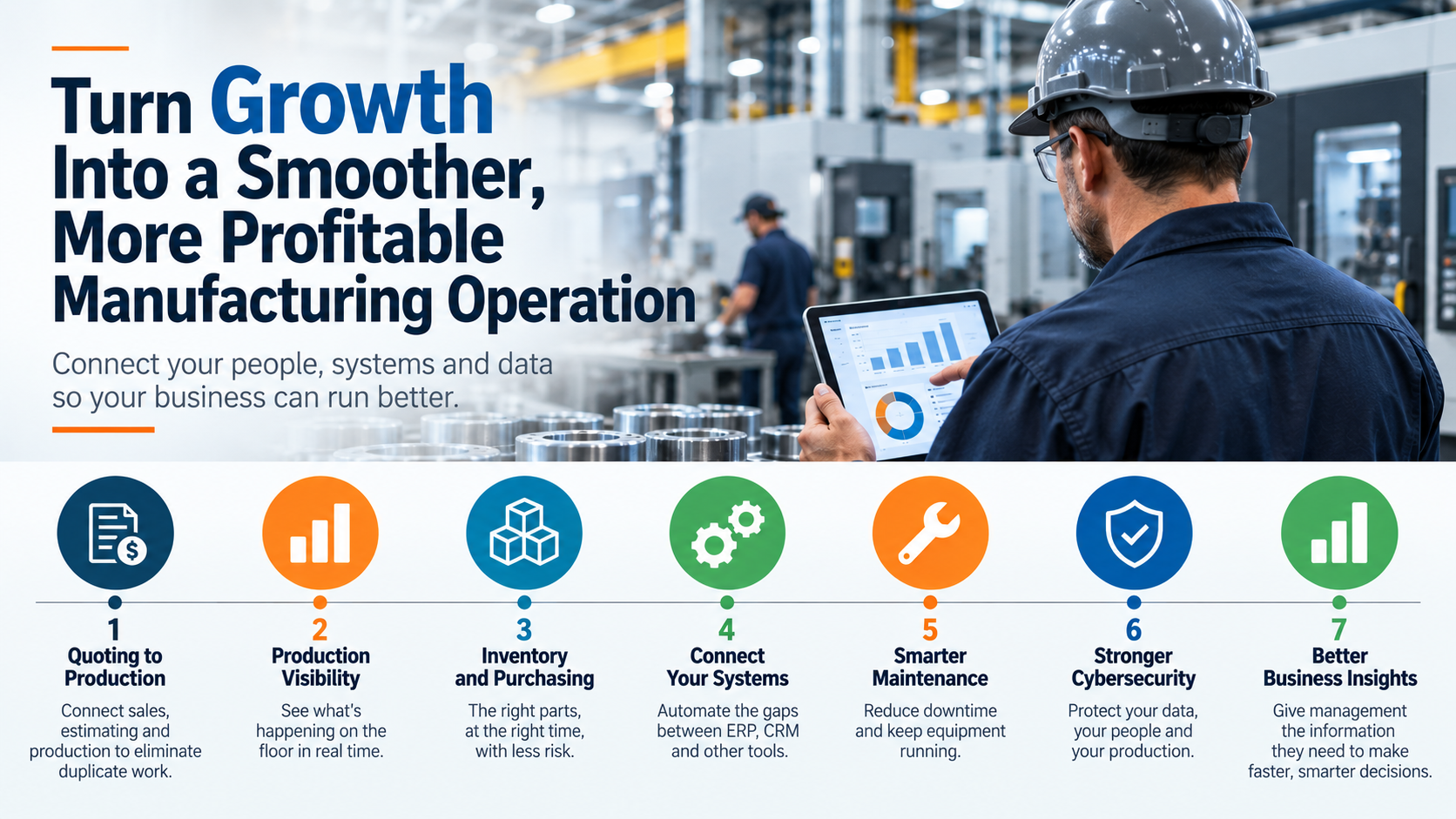
Manufacturing businesses become harder to manage as they grow because every increase in sales usually creates more quoting, scheduling, purchasing, inventory management, production coordination, maintenance, and reporting. At the same time, many manufacturers still rely on a mix of ERP software, spreadsheets, email, paper forms, shared drives, and manual processes that move information from one place to another.
As the company grows, those gaps create more delays, more errors, and less visibility. So what we do at Smartt is help make their operations easier to run by connecting the systems. This way, they can reducing manual work while giving management better information.
In our experience, manufacturers should review the following seven areas.
1. Connect Quoting, Sales, and Production
A lot of operational problems start before production begins because sales, estimating, and production are often working in separate systems. Sales may be working in a CRM, estimating may still rely on spreadsheets, and production may not receive complete information until after the job has already been won.
That creates duplicate entry and increases the chance that important details are lost.
Ideally, an approved quote should trigger the next steps automatically, including:
- Creating the customer or job in the ERP
- Creating the production order
- Passing specifications and drawings to operations
- Creating purchasing requirements
- Updating the CRM
- Triggering internal notifications
- Creating the correct project folders and documentation
The less information staff have to re-enter manually, the fewer opportunities there are for errors.
2. Improve Production Visibility
Management should be able to understand what is happening on the production floor without having to ask several people for updates.
At minimum, the business should be able to see:
- What is currently in production
- What is waiting for material
- What is behind schedule
- Current backlog
- Machine or work-centre utilization
- Production output
- Scrap and rework
- Labour used versus labour estimated
The system does not need to be complicated, but the information needs to be captured consistently and made available to the people who need it.
If production status still depends on someone walking through the plant and asking around, there is probably a better way to manage the process.
3. Connect Inventory and Purchasing
Inventory problems quickly become production problems, because too little inventory can stop a job while too much inventory ties up cash and warehouse space.
You should be able to answer basic questions quickly:
- What do we have?
- Where is it?
- What has already been allocated?
- What needs to be ordered?
- When is it expected to arrive?
- Which jobs are at risk because material is late?
- Which items are overstocked or rarely used?
Purchasing should also be connected to actual production demand rather than depending on someone noticing that stock is getting low.
Automation can help generate purchasing requirements, flag shortages, and notify staff before material delays begin affecting production.
4. Automate the Gaps Between Systems
Most manufacturers already have enough software. The bigger problem is usually that the systems do not work together.
There may be an ERP, CRM, accounting platform, quality system, shipping platform, CAD software, maintenance system, and several spreadsheets that have gradually become part of the business.
Look for places where employees repeatedly:
- Enter the same information twice
- Export and import spreadsheets
- Copy information from emails into another system
- Create jobs manually after a sale
- Update several systems when an order changes
- Reconcile reports because the systems do not agree
These are usually good automation opportunities.
5. Make Maintenance Less Reactive
Unexpected equipment downtime can be extremely expensive, so manufacturers should have a clear record of equipment condition, maintenance requirements, and recurring issues.
That should include:
- Equipment age
- Maintenance schedules
- Service history
- Downtime
- Failure history
- Parts replaced
- Operating hours
- Recurring issues
The objective is to reduce the amount of maintenance that happens only after something breaks. Once enough reliable data has been collected, the company can start looking for patterns and identify equipment that is becoming less reliable before it causes a major interruption.
Sensors and machine data can make this even more useful, but the starting point is much simpler: know what equipment you have, how it is performing, and when it needs attention.
6. Treat Cybersecurity as an Operations Issue
Manufacturing cybersecurity is not just about protecting email and office computers because a cyberattack can also interrupt production.
Manufacturers often have older equipment, industrial systems, remote-access tools, vendor connections, shared credentials, and computers that cannot easily be patched because they control important machinery.
At minimum, manufacturers should review:
- MFA for email, remote access, and critical systems
- Access controls for employees and outside vendors
- Separation between office and production networks
- Endpoint protection
- Patch management
- Backups
- Recovery procedures
- Remote-access tools
- Older systems that can no longer be properly secured
The important question is not only whether data can be restored, but also how quickly production can resume if a critical system becomes unavailable.
7. Give Management Better Operating Data
Owners and managers should not need to pull five different reports together to understand how the business is performing.
They should be able to quickly see:
- Sales backlog
- Production backlog
- Current capacity
- On-time delivery
- Material shortages
- Labour efficiency
- Machine utilization
- Scrap and rework
- Gross margin by customer or product
- Accounts receivable
- Major exceptions that require attention
This is also where AI can become useful, because once the underlying data is reliable, management may be able to ask questions such as:
- Which jobs are most likely to miss their delivery date?
- Where did scrap increase this month?
- Which customers have the lowest margins?
- Which machines had the most downtime this quarter?
- Which open orders are waiting on material?
The value comes from making existing business information easier to use rather than adding AI for its own sake.
Where Should You Start?
You do not need to replace everything at once. It is usually better to start with the areas where the business is losing the most time, money, or visibility.
Ask:
- Where are employees entering the same information more than once?
- Which spreadsheets have become critical to running the business?
- Where do production delays usually begin?
- What information does management struggle to get quickly?
- Which processes depend too heavily on one employee knowing how they work?
- Where do errors happen because systems are disconnected?
- What would stop production if a system or machine became unavailable?
Those answers will usually point to the highest-value improvements.
Important Tip: Build the Foundation Before Adding More AI
There is a lot of attention around AI in manufacturing, and some applications will create real value in areas such as document processing, forecasting, quality control, maintenance, internal knowledge, and production analysis. However, AI works much better when the underlying systems and data are already organized.
If inventory is inaccurate, production data is incomplete, and information is scattered across spreadsheets, adding AI does not solve the underlying problem.
The better approach is to improve the foundation first by connecting systems, improving data quality, automating repetitive work, strengthening cybersecurity, and giving management better visibility. Once that foundation is in place, AI can be added where it actually improves the business.
At Smartt, we help manufacturers identify these gaps, connect systems, automate repetitive processes, improve IT and cybersecurity, and determine where AI can create measurable value.
Through FlexHours, manufacturers can access IT, software, automation, cybersecurity, and digital expertise without having to build all of those capabilities internally.
If your manufacturing business has grown faster than the systems supporting it, the digital infrastructure probably needs to catch up. Feel free to to get in touch and see how Smartt may be able to help!