 Branding
 Digital Marketing
 Web & App Dev
 IT Services
Agile Marketing in the Age of AI
When agile marketing first gained traction, it felt naturally suited to startups - especially SaaS product companies. Small teams could make decisions quickly, launch minimum viable campaigns, learn from the results, and work alongside product teams to shape the customer roadmap without waiting for layers of approval.
Large enterprises had a harder time adopting the same model. Their marketing organizations were often built around annual plans, departmental silos, long approval chains, and multiple vendors responsible for different stages of execution. (One of the biggest complaints we still hear is that marketing can move faster than product development or R&D!)
AI is changing that dynamic. Marketing teams can now accelerate research, campaign ideation, copywriting, design, reporting, and even web development. At the same time, product teams can prototype, test, and release new features much more quickly.
This increase in speed across the business has changed the role of agility. In the age of AI, agile marketing is not simply a way to produce more content or launch campaigns faster. That often just leads to more AI slop rather than better marketing. Instead, agility is now about shortening the distance between insight, decision, execution, product development, and learning.
The New Problems:
Problem #1: AI Has Made Execution Faster, but Not Necessarily Better
AI has removed many of the production constraints that once slowed marketing teams down. Teams can summarize customer research, generate campaign concepts, draft messaging, create design variations, build prototypes, and analyze performance data much faster than before.
But speed alone does not create an advantage. Without strong direction, AI tends to produce work that is competent, familiar, and similar to what everyone else can generate. A company may publish more campaigns, create more content, and test more variations without becoming more distinctive or effective.
The risk is not simply that AI produces mediocre work (it doesn’t, if you use it properly). It is that organizations can now produce mediocre work at much greater volume.
Problem #2: The New Bottleneck Is the Organization
As execution gets faster, the slowest part of enterprise marketing increasingly becomes the organization itself.
A campaign concept may be created in an afternoon but take three weeks to approve. Customer data may reveal an opportunity, but marketing, sales, product, legal, and IT may not agree on who should respond. An AI-generated prototype may demonstrate a promising idea, but the project may still be trapped from decisions created months earlier.
Solution: What Agile Marketing Means in the Age of AI
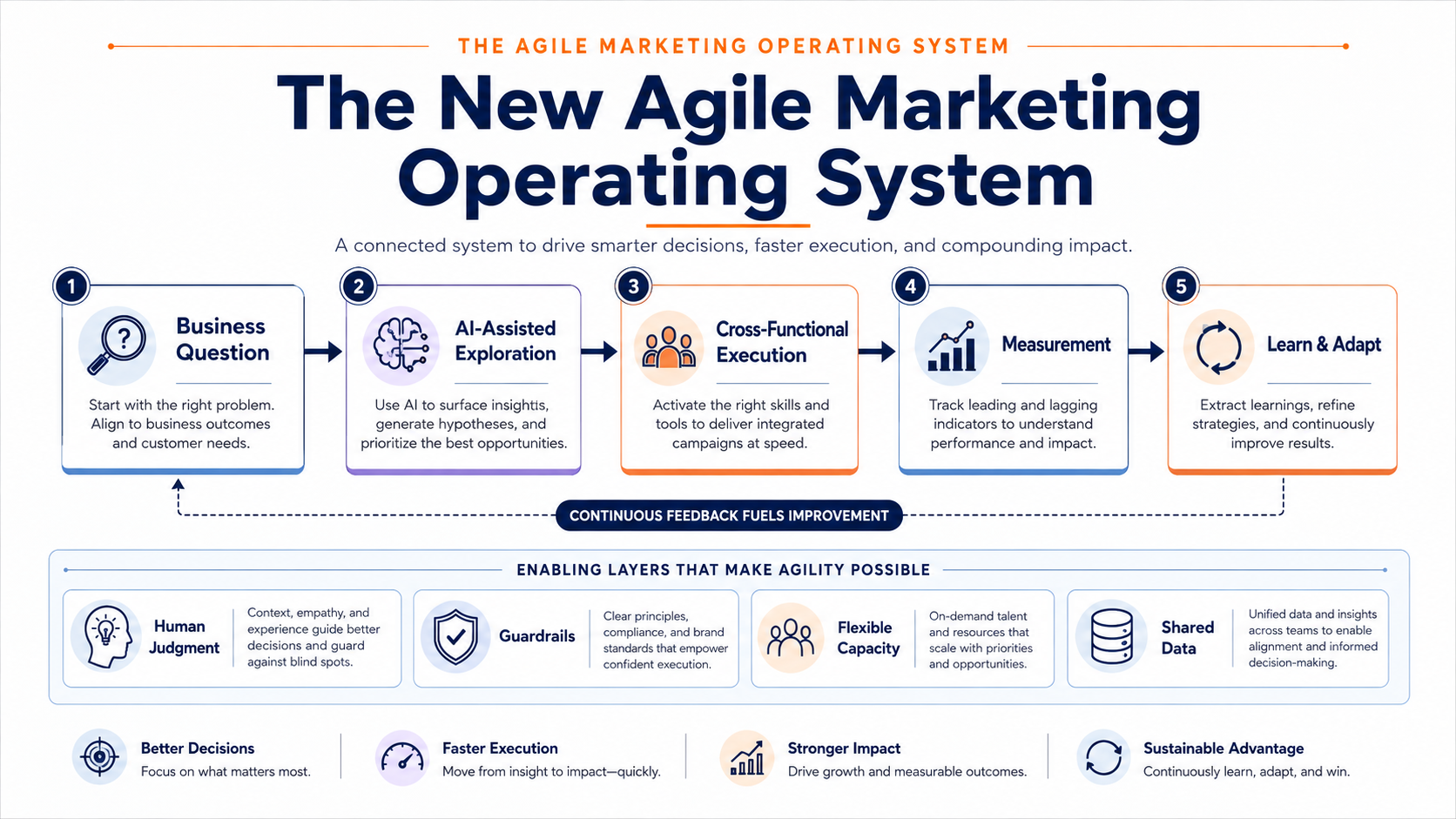
Agile marketing is sometimes reduced to sprints, stand-up meetings, and project boards. Those practices can help, but they are not the point. The purpose of agile marketing is to create a shorter and more reliable cycle between what the business learns and what it does next.
That means:
- Replacing large, infrequent bets with smaller experiments
- Prioritizing work based on current business value
- Bringing the right people into the process earlier
- Giving teams the authority to act within clear boundaries
- Using results to improve the next decision
AI can support every stage of this cycle. It can help teams explore ideas, analyze information, create prototypes, produce variations, and identify patterns.
Human judgment is still required to choose the right problem, decide what is worth testing, evaluate the quality of the work, and determine what the results mean. The advantage comes from combining machine speed with human judgment.
And with all this in mind, here are our tips for implementing agile marketing in the age of AI.
Tip #1: Start With a Business Question, Not an AI Tool
Many organizations begin their AI marketing efforts by asking which tools they should adopt. A better starting point is a meaningful business question.
Why are qualified leads failing to convert? Which customer segment offers the strongest growth opportunity? What message would make a new service easier to understand? Which part of the buying journey creates the most friction?
Once the question is clear, AI can help the team research, prototype, and test possible answers.
This keeps experimentation from becoming a series of disconnected tool demonstrations. The goal is not to prove that the marketing team can use AI. It is to improve a measurable business outcome.
A useful pilot may involve one audience, one campaign, and one clear objective. The team can compare results, document what it learned, and decide whether the approach deserves further investment.
Tip #2 Use AI to Explore More Ideas
One of AI’s greatest strengths is its ability to reduce the cost of creating alternatives.
A traditional campaign process may produce one main concept and a handful of variations because every additional option requires more time and budget. AI allows teams to explore more directions before making a major commitment.
Teams can quickly test different value propositions, audience segments, calls to action, visual approaches, landing-page structures, and content formats. Rough prototypes can be evaluated early, allowing weaker ideas to be discarded before significant resources are spent polishing them.
Note: This does NOT mean launching everything AI generates. The team still needs a point of view. It must decide which ideas reflect the brand, which assumptions are worth testing, and which outputs are too generic to create an advantage.
AI expands the number of possibilities. Agile methods just help the team narrow them through evidence.
Tip #3: Replace the Content Calendar With a Learning Agenda
Traditional marketing plans often focus heavily on outputs: a certain number of campaigns, articles, emails, events, or social posts. In the age of AI, that output is abundant. Most organizations can already produce more content than their audiences will ever consume, often in the form of AI slope.
A better agile plan would focuse on what the team needs to learn:
- Which customer problem creates the greatest urgency?
- Which message attracts the most qualified prospects?
- Which offer moves buyers from interest to action?
- Which channel reaches decision-makers most efficiently?
- Which objections prevent customers from moving forward?
- Which content helps sales advance real opportunities?
This turns marketing activity into a sequence of deliberate experiments.
Each sprint should produce more than deliverables and mere results. It should produce evidence that improves the next decision.
Instead of “Did we publish the campaign?” and “What conversions did we get”, we wat to “What did the campaign teach us?”
Tip #4: Organize Teams Around Outcomes
AI can accelerate the creation of campaign materials, but enterprise marketing still depends on systems, data, processes, and people outside the marketing department.
A lead-generation initiative may involve the website, CRM, analytics, sales follow-up, privacy requirements, automation, product information, and technical integrations. Faster content production will not solve the problem if those functions remain separated. Agile teams should therefore be organized around an outcome rather than a department.
A campaign team may include marketing, sales, web development, design, data, IT, and a product or subject-matter expert. Not everyone needs to attend every meeting, but the team must have access to the people who can make decisions and remove blockers. This reduces handoffs and prevents a common enterprise problem: every department completing its assigned task while the overall customer journey remains broken.
It can also reduce the growing gap between marketing and product development. Instead of marketing waiting for a finished product or product teams building without current market feedback, both sides can work from the same customer insights and learning priorities.
Tip #5: Give Teams Guardrails and Decision Rights
Enterprise leaders often say they want teams to move faster while still requiring every meaningful decision to travel through the existing approval structure.
That is not agility. Leadership should define the business objective, budget, brand requirements, legal constraints, data policies, and acceptable level of risk. Within those guardrails, the team should have the authority to test, learn, and adjust.
This becomes especially important when AI is involved. Employees need to know which tools are approved, what information may be entered into them, when expert review is required, and which uses are prohibited.
Once those rules are established, teams should not need permission for every prompt, campaign variation, or small experiment.
Good governance should make responsible action easier. It should not recreate the same approval bottlenecks under a new name.
Tip #6: Use AI to Stretch What Your Team Can Create
AI should not only help teams produce familiar marketing materials faster. It should also make previously impractical ideas possible.
A team that has never produced animation might experiment with claymation-style video ads. A manufacturer might turn technical specifications into interactive infographics, 3D product models, exploded-view animations, or virtual demonstrations. A professional-services firm might transform its expertise into an assessment tool, interactive calculator, personalized report, or simulated customer scenario.
More advanced possibilities include creating digital twins of physical products, building virtual showrooms, generating localized video campaigns for multiple markets, developing interactive product configurators, visualizing complex operational data, or creating prototypes of new customer experiences before committing to full production.
The goal is not to use new formats simply because they are possible. The work still needs to support the strategy, reflect the brand, and help customers understand or experience something more clearly.
But agile teams should deliberately include some experiments that stretch their existing capabilities. When the cost of prototyping falls, organizations can explore ideas that would previously have been dismissed as too expensive, too technical, or too time-consuming.
AI can make the first version achievable. Agile marketing gives the team a way to test whether the idea deserves to become something more.
Tip #7: Have a Vendor Model That Provides Flexible Capacity
Agile marketing becomes difficult when every change in priority requires a new scope, budget approval, or vendor agreement.
A campaign may begin as a messaging exercise and quickly reveal the need for landing-page development, analytics configuration, CRM integration, sales enablement, creative production, or AI workflow design. Traditional vendor models often treat each requirement as a separate project, which creates delays precisely when the team needs to respond to what it has learned.
Smartt’s FlexHours model allows businesses to reallocate resources as priorities evolve. One sprint may focus on customer research and campaign strategy. The next may require web development, automation, analytics, creative production, or technical integration. And because these capabilities are available through one multidisciplinary team, the business can act on new information without rebuilding the engagement each time.
This is particularly valuable in the age of AI. The first prototype may arrive quickly, but turning it into a secure, integrated, and effective business process often requires several different disciplines.
Agility Is the Ability to Learn Faster
In the age of AI, the best marketing teams will learn faster and use what they learn to make the business better.
Smartt helps organizations bring strategy, creative, web development, automation, analytics, AI, and IT capabilities together through one multidisciplinary team.
With FlexHours, you can shift resources as priorities change, test new ideas without creating a new project for every requirement, and turn promising experiments into secure, integrated business solutions. Talk to Smartt about building a more agile marketing operation.