 Branding
 Digital Marketing
 Web & App Dev
 IT Services
AI Is Changing the Economics of Business Hardware
AI Is Changing the Economics of Business Hardware
For years, hardware lifecycle management was fairly predictable. A company bought laptops, desktops, servers and network equipment, used them for a few years, and replaced them when they became too old or unreliable.
But AI has completely changed that equation…and not for the better,
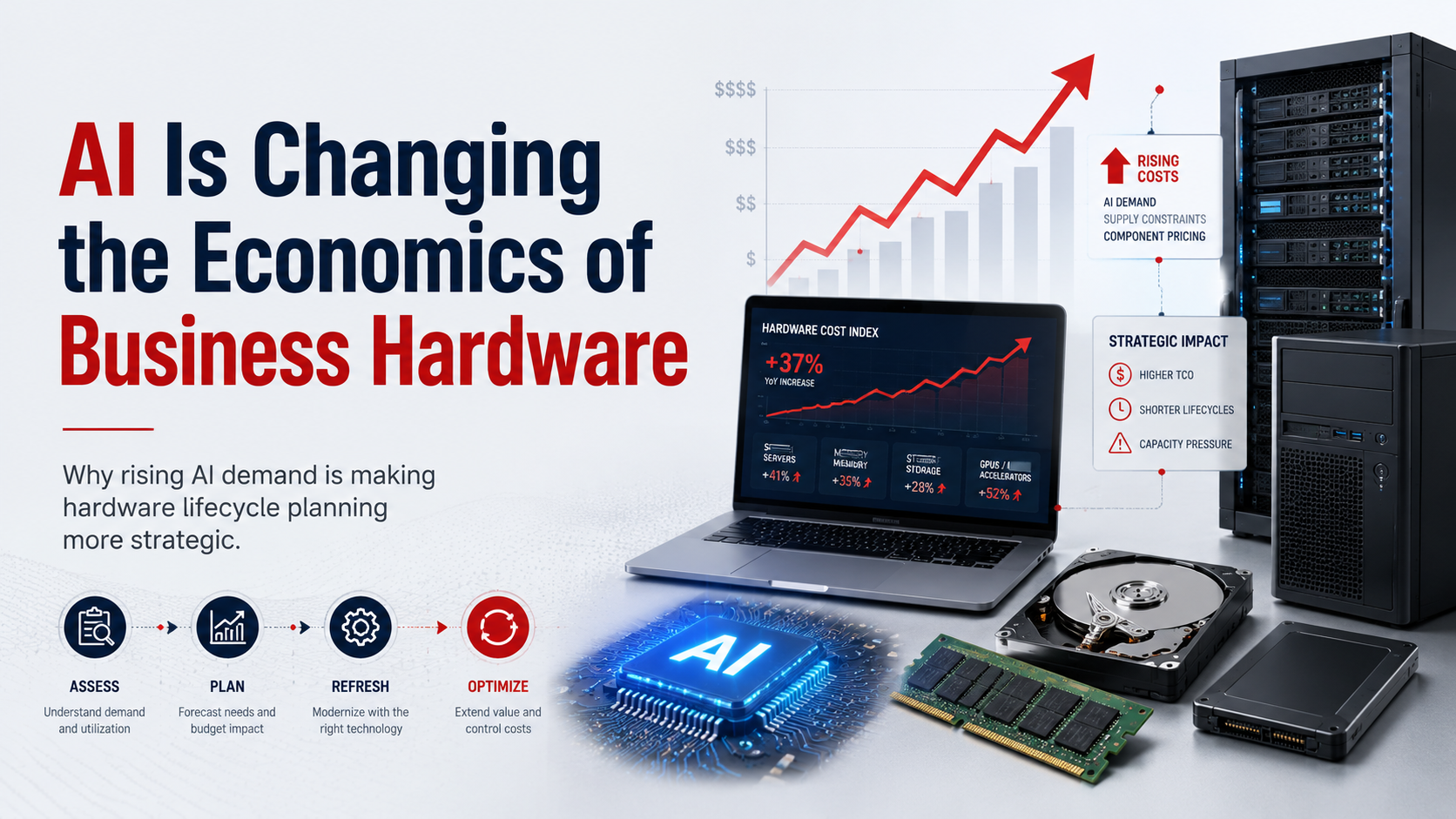
Nvidia is reportedly telling major customers that prices for servers containing its AI chips will increase by more than 15% in many cases, with the increases expected to affect systems shipping in early 2027. One of the biggest reasons is the rapidly rising cost of memory.
And Nvidia isn't alone. Memory prices have risen dramatically as AI data centres consume more of the world's available production. TrendForce expects conventional DRAM contract prices to rise another 13-18% in Q3 2026 and NAND Flash prices another 10-15%, even after much larger increases earlier in the year. Manufacturers are increasingly prioritizing the higher-margin memory used in servers and AI infrastructure, leaving less capacity available for PCs and other devices.
We can already see the effects further down the supply chain. Apple's Mac mini has become surprisingly popular as a relatively inexpensive machine for running local AI workloads. Demand combined with memory shortages has resulted in some higher-memory configurations having delivery times measured in months. Apple has also already increased pricing on some Mac configurations, including a $200 increase to the M4 Pro Mac mini earlier this year.
Nobody knows exactly what the next generation of Macs, PCs or servers will cost. But it’s clear prices will continue to go up for the next few months, if not years. When the components inside those systems are becoming substantially more expensive, assuming that next year's hardware will simply be faster and cheaper is no longer necessarily a safe assumption. Chances are, you either pay more for the same, or you pay an arm and a leg for better.
Hardware Procurement Is Becoming More Strategic
What this means for businesses is that hardware should be actively managed.
For example, if we know that 15 computers will probably need replacement over the next 18 months, it may make sense to look at their condition now rather than waiting for all of them to reach an arbitrary replacement date.
Some might need to be replaced earlier while pricing and inventory are favourable. (And you may put in an order ahead of time knowing it’s going to take 3 months to ship anyway. )
Others might be perfectly capable of running for another two years.
A few may simply need additional memory, storage, a battery replacement or some cleanup and optimization. And sometimes a machine that is no longer appropriate for one employee can be repurposed for another role rather than retired…or even gutted for parts.
The objective here is to get the best combination of reliability, performance, security and cost over the entire lifecycle of the equipment.
Sometimes the Best New Computer Is No New Computer
There is also another side to hardware lifecycle management that is becoming increasingly important: asking if we need another new machine before we buy it.
For certain workloads, we can spin up a virtual machine instead. For example, a temporary development environment, test server, automation workload or specialized application doesn't necessarily need another computer sitting in an office.
A virtual machine can sometimes be created when it is needed, resized when requirements change and shut down when it is no longer required.
The same thinking applies to existing infrastructure. We can look at whether servers are being properly utilized, whether workloads can be consolidated, whether older equipment can be reassigned, and whether cloud or virtual resources make more sense for applications with irregular demand.
AI itself is making this discussion more interesting. Some workloads make sense in the cloud, while others may make more sense running locally, especially when a company already owns capable hardware.
Getting More Out of What You Already Own
Hardware lifecycle management also means paying attention to the equipment that is already there. A computer that feels slow isn't necessarily obsolete.
Sometimes the problem is software running unnecessarily in the background. Sometimes storage is nearly full. Sometimes the operating system has accumulated years of applications and services. Sometimes a relatively inexpensive upgrade can materially extend the useful life of the machine.
The same principle applies beyond computers. Network switches, Wi-Fi equipment, firewalls, servers, backup appliances and other infrastructure should all be looked at as part of an overall lifecycle rather than replaced only when something finally stops working.
That gives us the ability to make deliberate decisions instead of expensive emergency purchases.
And that becomes much more valuable when prices are volatile and certain configurations can suddenly become difficult to source.
Where FlexHours Fits
This is one of the reasons hardware lifecycle management can become an important part of FlexHours for many of Smartt’s clients.
Instead of treating hardware purchasing as something separate that comes up every few years, we can continually look at what the company owns, what is approaching end of life, what can be extended, what should be replaced, and what could be handled differently.
FlexHours can be used to plan migrations, configure new systems, optimize existing machines, build virtual environments, move workloads, automate deployments and help determine what actually needs to be purchased. FlexHours clients also have access to Hardware Credit, giving them another way to put their technology investment toward the equipment the business actually needs.
This way, we help you go from “This computer is old. Should we buy another one?” to "What is the most effective way to provide this capability over the next three to five years?"
Sometimes the answer will be new hardware, sometimes it will be extending the life of what you already have, and sometimes it will be moving the workload somewhere else entirely!
With AI putting increasing pressure on the world's computing, memory and storage supply chains, making that decision well is becoming a much bigger part of managing IT, and we are here to help if you nee us! Feel free to reach out and see how our FlexHours program and included hardware credit can work for you.