 Branding
 Digital Marketing
 Web & App Dev
 IT Services
The Real Cost of Technology Vendor Sprawl
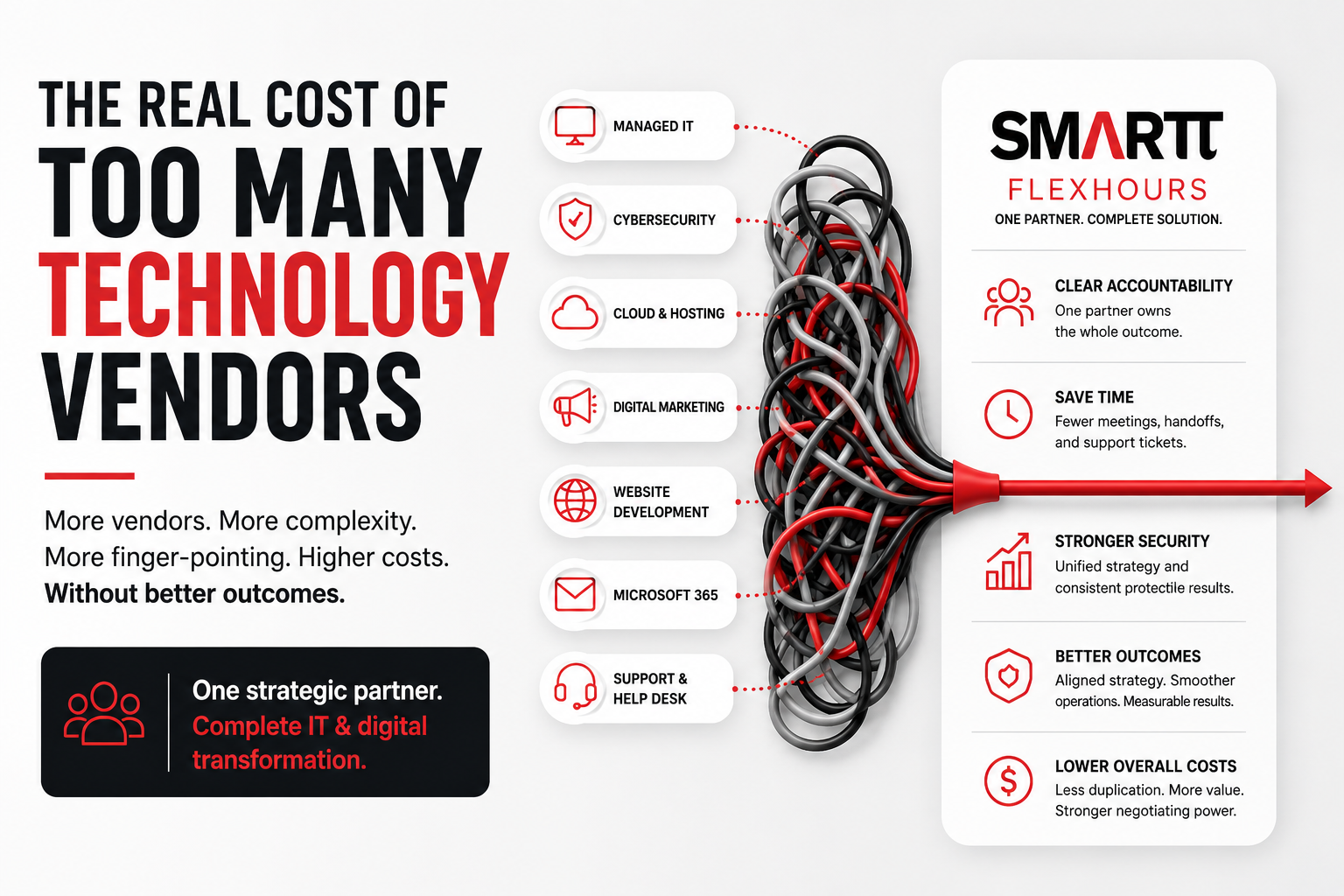
Technology has become increasingly specialized over the past decade. As businesses adopted new tools and services, they also accumulated new partners to support them. A web developer built the website. A digital marketing agency managed advertising campaigns. An MSP looked after desktops and servers. Basically, a different vendor handled Microsoft 365, cybersecurity, cloud backups, VoIP, hosting, networking, and SEO, etc.
None of these decisions were wrong on their own, as each vendor had likedly solved an immediate business need at the time. The problem is that very few organizations ever step back and ask whether this collection of vendors still makes sense as a whole.
Over time, businesses often find themselves managing ten or fifteen technology providers, each responsible for a small piece of the puzzle. While every vendor may be competent within their own specialty, the overall technology environment becomes increasingly difficult to coordinate. The hidden costs are not usually found on the invoices, but in the time spent managing suppliers, the delays caused by miscommunication, and the lack of clear accountability when something goes wrong. Not to mention, the business would miss out on synergies that come with a multi-disciplinary perspective.
More Vendors Usually Means More Complexity
Every additional technology partner introduces another relationship that needs to be managed: Contracts need renewing, meetings need scheduling, and support requests need coordinating. And to top if ott, staff need to know who to contact for which issue.
None of these tasks are particularly difficult on their own, but together they create a surprising amount of administrative overhead. The more providers involved, the more time your team spends coordinating vendors instead of working on initiatives that move the business forward.
Perhaps more importantly, every vendor sees only their own piece of the technology ecosystem. A web developer naturally focuses on website performance at the detriment of everything else. The same with your cybersecurity provider. And your marketing agency. And your managed IT provider. Instead of colloborating, they begin finger pointing from a narrow frame of mind that's tied in to their own metric you judge them on.
Whilst the different perspectives are still all valuable, they likely won't always be aligned with one another or with your broader business objectives. Someone needs to balance competing priorities and ensure the technology ecosystem functions as a cohesive whole rather than a collection of independent services, which is kind of difficult when there are multiple internal stakeholders with different objectives too. Meetings and projects become more about turf wars than moving the business forward.
When Something Breaks, Accountability Often Disappears
Most businesses have experienced some version of the same problem. A website suddenly goes offline: the hosting company says the issue is related to DNS, the DNS provider believes it is a firewall configuration, while the managed IT provider points toward the web server. Meanwhile, marketing campaigns stop working, customers cannot submit forms, and internal staff are left coordinating conversations between vendors who may never have worked together before.
The issue is not necessarily that any individual vendor is doing a poor job, but that no one owns the complete outcome.
Technology rarely exists in isolation anymore. Your website connects to your CRM, which in turn connects to your marketing platform. Your email depends on your identity provider. Your employees rely on cloud infrastructure, cybersecurity tools, networking, backups, and collaboration systems that all depend on one another.
When every component is managed by a different company, solving even a relatively simple problem becomes slower and more complicated than it should be. Each handoff creates another opportunity for delay, misunderstanding, or finger-pointing.
Conflicting Advice Creates More Work for Your Team
Multiple providers can also create a stream of recommendations that are individually reasonable but collectively difficult to manage. The cybersecurity provider may recommend stricter access controls. The marketing agency may need additional tracking scripts. The web developer may want to change the hosting configuration. The IT provider may be concerned about how those changes affect performance or security.
Without one partner looking across the entire environment, the burden of deciding which recommendation takes priority falls back on the client. Internal staff are forced to become translators and referees between specialists, even when they do not have the technical context needed to evaluate every trade-off.
This is one of the most overlooked costs of vendor sprawl: Businesses are not just paying for multiple services, but they are also paying, in time, attention, and mistakes, to make those services work together.
Vendor Consolidation Does Not Mean Sacrificing Expertise
Some organizations hear the phrase vendor consolidation and assume it means giving up specialized expertise or settling for a provider that does everything adequately but nothing particularly well.
That is not the goal. The objective is to reduce unnecessary fragmentation by working with a partner that understands multiple disciplines and can coordinate the broader technology strategy. Specialists may still be needed for certain projects, but they should be brought in intentionally, not accumulated by default.
Instead of separately managing providers for IT support, cybersecurity, Microsoft 365, cloud services, connectivity, hosting, website development, digital marketing, and strategic technology planning, many organizations can consolidate several of those services under one primary relationship.
This creates fewer handoffs, clearer accountability, faster decisions, and a much simpler experience for the business without eliminating access to the expertise it needs.
Focus on Outcomes, Not the Number of Suppliers
There is no perfect number of technology vendors that every business should have. Some organizations will always require specialized providers for particular systems, industries, or projects.
What matters is whether the technology ecosystem has been designed intentionally. Every provider should have a clearly defined purpose, a logical role in the overall environment, and a level of value that justifies the coordination required to manage the relationship.
If your team spends more time coordinating between suppliers than working on strategic initiatives, it may be time to reconsider how your technology services are delivered. The goal is not simply to reduce the vendor count. It is to create a model where responsibility is clear and every provider contributes to a shared business outcome.
Questions to Ask During a Vendor Consolidation Review
- Which providers are responsible for overlapping or closely related services?
- How much internal time is spent coordinating meetings, support requests, renewals, and escalations?
- When an issue crosses multiple systems, who is responsible for owning the final outcome?
- Are different vendors providing conflicting recommendations?
- Could one strategic partner deliver or coordinate several of these services more effectively?
- Are you paying for duplicated tools, support agreements, or management layers?
These questions often reveal that the largest opportunity is not simply reducing invoices. It is simplifying the way technology decisions are made, implemented, and supported across the organization.
How Smartt FlexHours Helps
Smartt created FlexHours around a simple idea: businesses should not have to manage a dozen separate technology relationships to get the support and expertise they need.
FlexHours brings together managed IT services, cybersecurity, Microsoft 365, cloud infrastructure, hosting, connectivity, website development, digital marketing, strategic technology planning, and ongoing business improvements under one flexible partnership.
Instead of acting as another isolated supplier, Smartt works as an extension of your team. We look across the entire environment, coordinate the moving parts, identify gaps and duplication, and help ensure your IT and digital services support the same business objectives.
That does not necessarily mean replacing every specialist you work with. Instead, it means giving your organization one trusted partner that understands how everything fits together, takes responsibility for the broader outcome, and coordinates outside providers when additional expertise is required.
FlexHours can also include software licences, with discounted pricing available for additional licences. This helps organizations simplify not only service delivery, but also procurement, billing, support, and ongoing vendor management.
The result is fewer relationships to manage, clearer accountability, stronger security, faster decision-making, and a more cohesive technology environment that is easier to operate today and better positioned to support future growth. Interested? Reach out and let's have a conversation!