 Branding
 Digital Marketing
 Web & App Dev
 IT Services
How to Build IT Credibility With the Executive Team
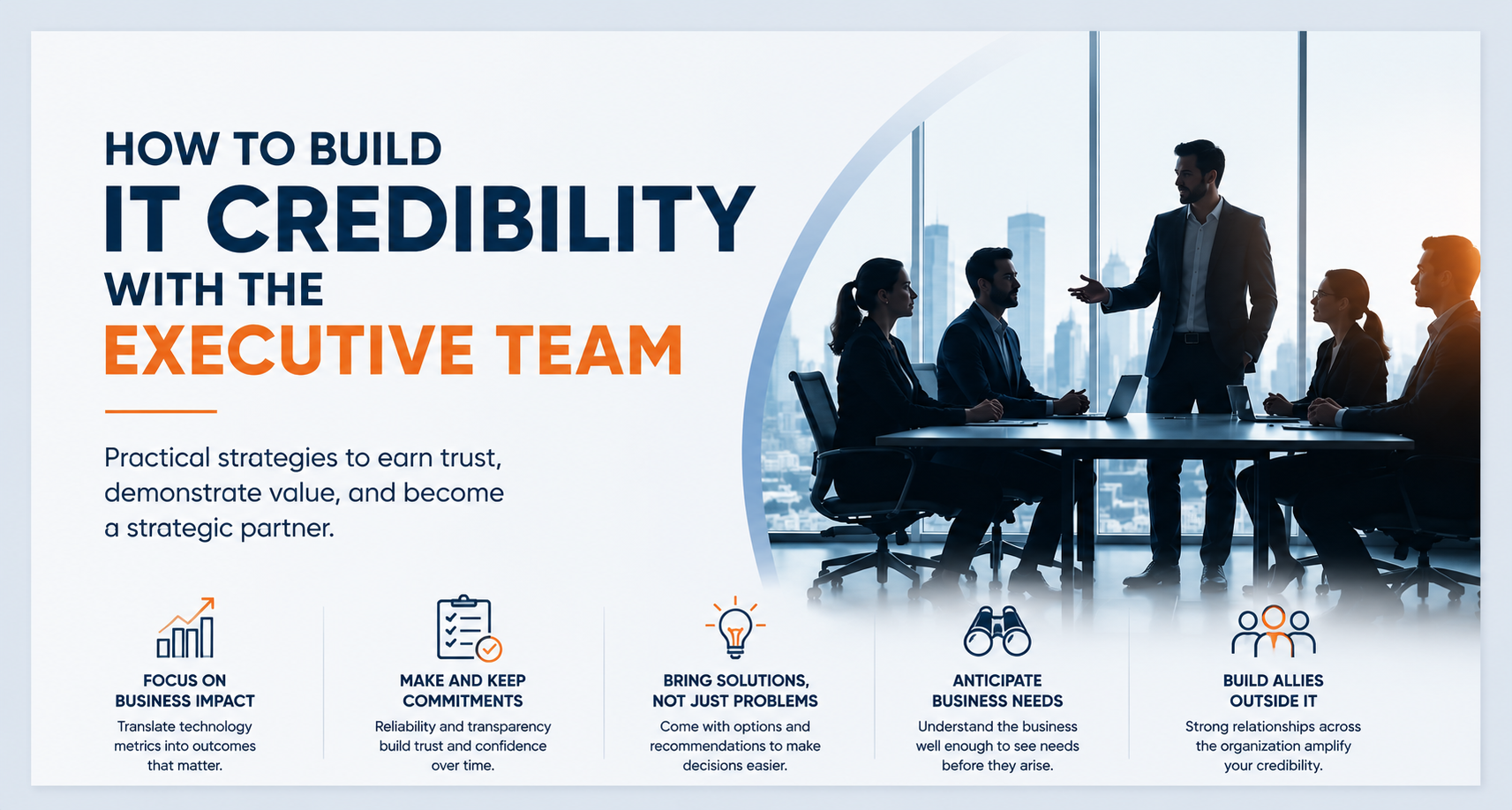
Technical expertise may get you hired, but it won't earn you a seat at the executive table.
Many IT leaders assume that delivering reliable systems, keeping projects on schedule, and resolving incidents quickly will naturally earn the respect of senior leadership. While those things are essential, they are only part of the equation.
Executive credibility isn't built by technical competence alone, but through communication, consistency, business understanding, and trust.
The unfortunate reality is that credibility is built slowly and can be lost remarkably quickly. (It's almost like the saying, "You're only as good as your last show" in show business." Instead, it's "You're only as good as your last project." A few missed commitments, presentations filled with technical jargon, or a pattern of reacting to problems instead of anticipating them can cause leadership to see IT as a necessary expense rather than a strategic partner.
The good news is that credibility can be intentionally developed over time.
1) Stop Reporting on Technology. Start Reporting on Business Outcomes.
Executives rarely make decisions based on technical metrics alone.
While uptime percentages, patch compliance, ticket counts, and server health are important operational indicators, they don't answer the question executives care about most:
How does this affect the business?
Consider the difference between these two updates:
“Our infrastructure maintained 99.7% uptime this quarter.”
Versus:
“Our systems remained available for 99.7% of business hours this quarter. The brief outage resulted in approximately $12,000 in lost productivity, and we've already implemented changes that reduce the likelihood of it happening again.”
The underlying data is identical.
The second version demonstrates business awareness. It speaks the language of leadership and shows that IT understands the organization's priorities.
Every technical metric should ultimately answer one question:
Why does this matter to the business?
2) Reliability Builds Trust More Than Heroics
One of the fastest ways to build credibility is surprisingly simple.
Do exactly what you said you were going to do.
Every meeting with leadership should include at least one clear commitment. Whether it's delivering a proposal, investigating an issue, producing a roadmap, or implementing an improvement, establish a specific expectation and meet it.
Over time, executives begin to associate IT with predictability and reliability. Just as important is how you handle the commitments that don't go as planned. For example, projects occasionally slip due to unexpected issues that arise. In these cases, the loss of trust rarely comes from the delay itself, but from executives discovering the delay after they expected the work to be complete. At Smartt, we like saying that proactive communication demonstrates ownership. Waiting until someone asks for an update creates uncertainty. When a project is at risk, then communicate even more oftan than the current cadence. Reach out more often and before the stakeholder or client reaches out to you.
3) Never Bring Only Problems
Executives hire leaders to solve problems, not simply identify them. So , whenever you have to present an issue, arrive with ready-to-go options.
Instead of saying:
“Our backup infrastructure is reaching capacity.”
Frame it like this:
“Our backup infrastructure will reach capacity within six months. We've evaluated three options. Based on cost, scalability, and operational impact, we recommend Option B.”
Leadership still makes the decision, but you have made their decision easier by doing the analysis ahead of time.
IT becomes significantly more valuable when it provides clarity rather than complexity.
4) Learn the Business Well Enough to See Around Corners
The most trusted IT leaders don't wait for requests.
They anticipate them.
Perhaps the company is expanding into a new region, opening another office, hiring aggressively, or acquiring another business.
Each business initiative creates technology implications long before anyone formally asks IT for assistance.
Imagine hearing this from your IT leader:
“I noticed we're planning to expand into Western Canada next quarter. Based on that timeline, we'll need to begin network planning within the next four weeks to avoid delays.”
That conversation immediately changes how leadership views IT.
Instead of being a department that reacts to requests, IT becomes a strategic partner helping move the business forward.
Understanding the organization's goals is just as important as understanding its technology.
5) Build Credibility Across the Organization
Executive perception is influenced by more than executive interactions.
Leaders regularly talk to one another. SO when department heads consistently mention that IT solved problems quickly, communicated clearly, or helped them achieve their objectives, those conversations build your reputation long before your next executive meeting.
Strong relationships with Finance, Operations, Sales, Marketing, and HR create advocates throughout the organization.
People naturally trust recommendations from colleagues they already respect.
In many cases, your reputation enters the boardroom before you do!
6) Shift From Service Provider to Strategic Partner
The highest-performing IT organizations aren't viewed as help desks or infrastructure teams, but as business enablers. That shift happens when IT demonstrates an understanding of business priorities, communicates effectively, delivers consistently, and helps leadership make better decisions.
As we say internally "Technology is the invisible foundation; outcomes and results are what build value and earn business credibility and influence."
How Smartt Helps
At Smartt, we believe IT should be one of the most strategic functions within an organization.
Our FlexHours model gives businesses access to experienced IT leadership, strategic advisory services, and proactive technology planning alongside day-to-day operational support.
We help organizations improve communication with executive teams, build reporting that focuses on business outcomes rather than technical metrics, and position IT as a driver of growth instead of simply a cost of doing business.
When IT earns credibility, the entire organization benefits - so get in touch and see if we may be a good fit for each other!