 Branding
 Digital Marketing
 Web & App Dev
 IT Services
Why Hospitality Businesses Need a Better Digital Infrastructure Than They Think
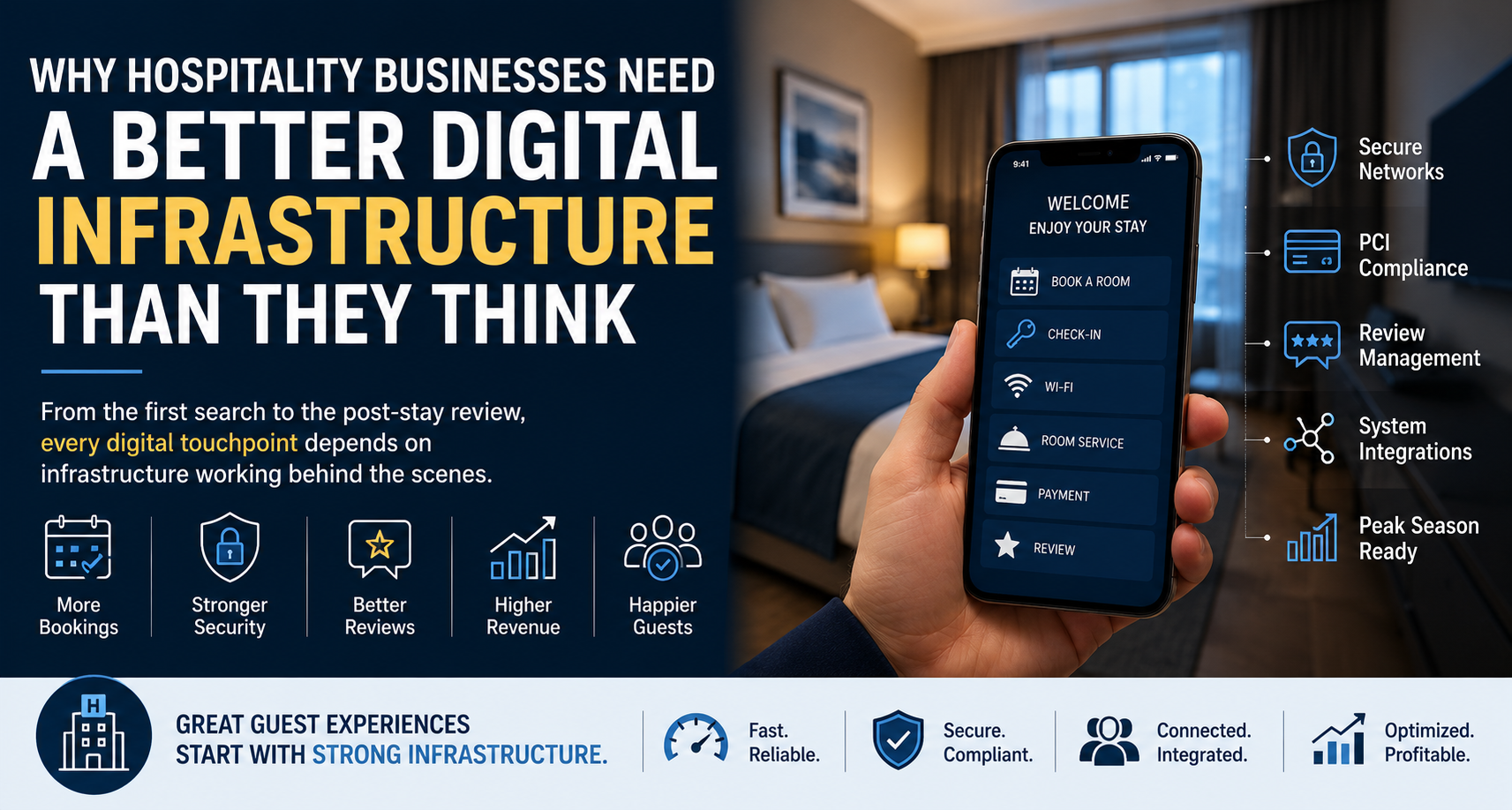
Hospitality is one of the most digitally dependent industries in existence, and one of the least rigorous about the infrastructure that digital experience depends on.
A guest books a room online, checks in on their phone, connects to the property Wi-Fi, orders room service through a tablet, pays at checkout through an integrated POS, receives a follow-up email with a review request, and leaves a public rating that influences the next hundred bookings. Every one of those touchpoints is a digital system. Every one of those systems can fail.
Most hospitality businesses invest heavily in the guest-facing experience and underinvest in the infrastructure underneath it. The result is a digital presence that looks polished on the surface and breaks in ways that are invisible until they cost real revenue.
1. Your Booking System Is a Revenue Engine
Online booking is where most hospitality revenue originates, and most properties treat their booking system as a utility rather than a strategic asset.
A poorly configured booking environment loses guests at every friction point:
- Slow page load speeds during peak search periods when guests are actively comparing options
- Mobile experiences that are functional on desktop but broken on the devices most guests are actually using
- Booking flows that require too many steps and see high abandonment rates that never get measured
- No retargeting to recapture guests who started a booking and did not complete it
- Disconnected rate management that creates inconsistencies between your direct site and third-party channels
The booking system should be monitored for performance, tested regularly, and optimized with the same discipline you would apply to any sales channel. Most properties do none of this.
2. Property Wi-Fi Is Guest Infrastructure
Guest Wi-Fi is no longer a differentiator. Not only is it expected, but a poorly managed Wi-Fi environment creates problems beyond guest complaints.
For example, when guest, staff, and operational networks share the same infrastructure without proper segmentation, a guest device can become a pathway into your POS system, your property management software, or your staff communication tools. This is not a theoretical risk, but a documented attack vector that hospitality businesses are targeted through regularly.
Every property should maintain separate network segments for guests, staff, and operational systems. Guest devices should never have visibility into the systems that run the business.
3. PCI Compliance Is Not Optional
Any property accepting card payments is subject to PCI DSS and other standards.
Common compliance gaps in hospitality include:
- POS terminals that have not been updated or audited in years
- Staff using shared login credentials for payment systems
- Card data handled in ways that exceed what the payment processor actually requires
- No documented incident response plan for a payment breach
- Guest Wi-Fi routed through the same network segment as payment infrastructure
A breach at a small property can result in fines, card processing suspension, and reputational damage that a thin-margin business cannot absorb. Compliance is a risk management decision, not just a regulatory checkbox.
4. Your Review Pipeline Is a Marketing System
Online reviews are the primary trust signal for hospitality businesses. A one-star improvement in average rating has been shown to correlate directly with measurable revenue increases. Yet many properties manage reviews reactively, responding only when prompted and collecting them haphazardly.
A managed review pipeline looks like:
- An automated post-stay email sequence that makes it easy for satisfied guests to leave a review on the platforms that matter most
- A process for flagging and responding to negative reviews within 24 to 48 hours
- Regular reporting on review volume, average rating, and the common themes in guest feedback
- Integration between review data and operational decisions so that recurring complaints are actually addressed
This is a marketing system running on email automation, CRM configuration, and consistent process. Although it does not require dedicated staff 24/7, it does requires setup, check ups, and maintenance.
5. Seasonal Spikes Expose Infrastructure Weaknesses
High season often reveals infrastructure problems.
Slow websites, broken booking integrations, overwhelmed help lines, and POS failures during peak periods are symptoms of infrastructure that was never sized or tested for peak demand. The cost of these failures is concentrated in the exact weeks when revenue potential is highest.
Before peak season, hospitality businesses should run through a checklist that includes:
- Load testing the booking environment and main website under simulated peak traffic
- Confirming that hosting can scale automatically if traffic surges
- Testing all payment integrations end-to-end
- Auditing staff access and confirming that no accounts from previous seasons are still active
- Verifying that backups are running and that a recent restore has been tested
6. The Integration Problem Nobody Talks About
Most hospitality properties run a property management system, a channel manager, a booking engine, a POS, a CRM, and an email marketing platform. In many cases, these systems do not talk to each other.
The practical result is that data lives in silos: Revenue data is in one system, guest history is in another. And marketing lists are manually exported and imported. Nothing is real-time and decisions are made on incomplete information.
Connecting these systems through integrations and APIs will allow you to know who your most valuable guests are, what they booked, when they are likely to return, and how to market to them with relevance. Without it, every guest interaction starts from zero.
The Infrastructure Beneath the Experience
Guest experience in hospitality is increasingly digital from the first search to the post-stay review. The properties that will maintain and grow occupancy are the ones that treat the digital infrastructure underlying that experience with the same care they give to physical renovations and staff training.
At Smartt, we work with hospitality businesses to audit and improve their digital infrastructure, from booking system performance and network security to CRM integration and review automation. FlexHours gives you access to the technical and marketing expertise to close these gaps without building an in-house team. If your digital infrastructure has not been reviewed recently, that review is the right place to start. Feel free to reach out for an initial conversation!