 Branding
 Digital Marketing
 Web & App Dev
 IT Services
How to Turn Customer Data Into a Marketing Strategy
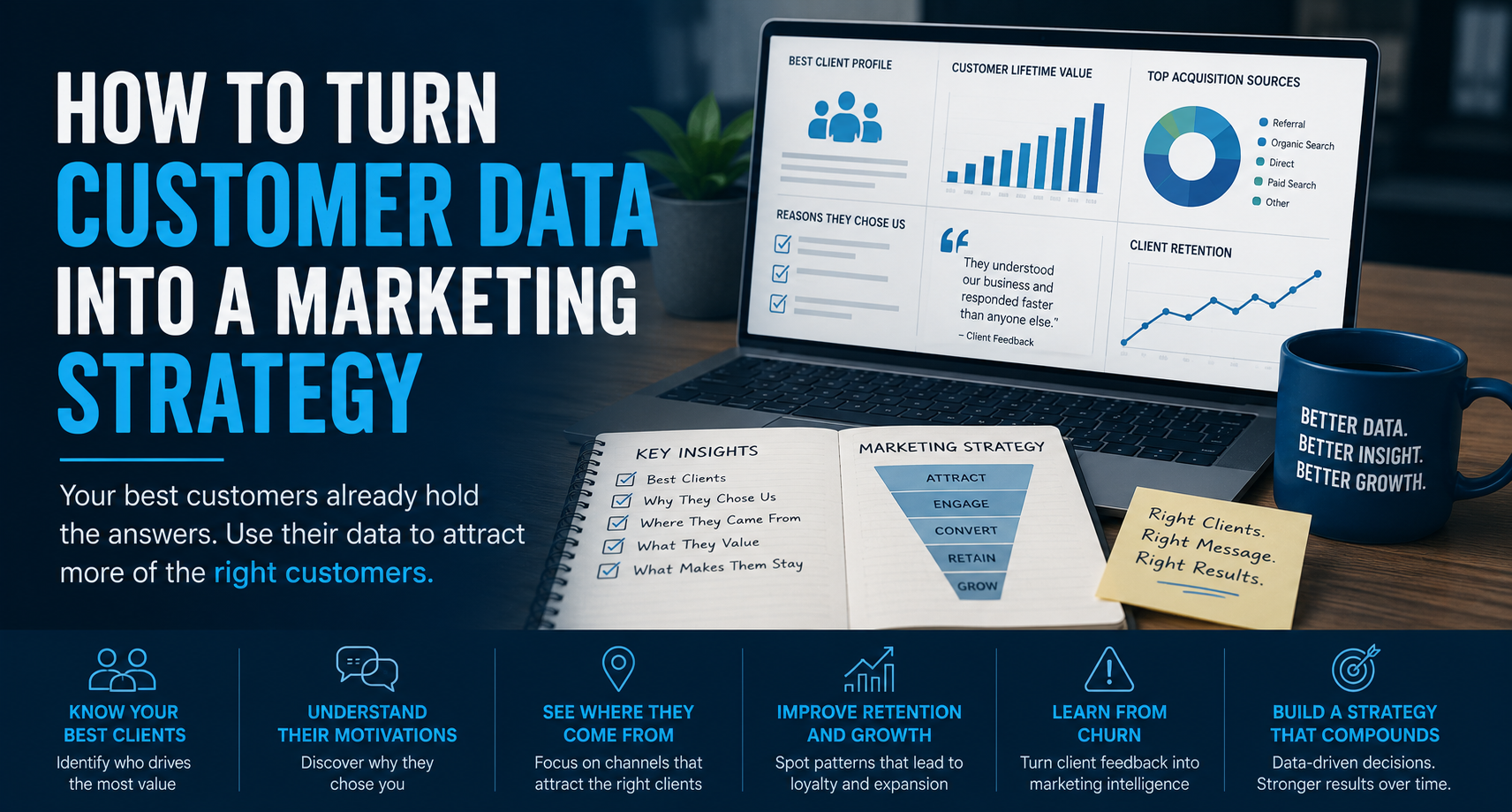
How to Turn Customer Data Into a Marketing Strategy
Last time we wrote about using the web to conduct digital competitive analysis. Today let's talk about how to mine your existing customer database.
Most businesses are actually sitting on more actionable marketing intelligence than they realize, and almost none of it requires external research. It lives in the CRM, in the closed/won records, in the patterns of which clients stay longest and refer most, and in what clients actually say when asked.
And a marketing strategy built from this data often produces better results than one built from industry benchmarks, because it is specific to the actual buyers who have already chosen you.
1. Analyze Your Best Clients First
Define your 'best client' in terms that matter to the business, such as highest lifetime value, highest referral rate, fastest to close, or easiest to serve at margin. (Sometimes it helps to plot things in a quadrant.) Then describe what these clients have in common:
- Industry and company size
- The challenge or trigger that led them to engage you
- How they found you
- What they valued most about the relationship
- What language they used to describe their problem before engaging you
Build the inverse of this profile as well. Clients who were difficult to serve, slow to close, or quick to churn often share patterns too. Identifying red flags in how those clients arrived, what they asked, and what they expected gives you disqualification criteria as useful as any qualification checklist.
2. Mine Close/Won Records for Positioning Insight
The reasons clients chose you over alternatives, captured in CRM notes or in post-sale conversations, are the raw material of differentiated positioning.
If ten clients in a row said they chose you because you responded faster than anyone else they evaluated, that is a positioning signal. If they consistently describe the problem they had before engaging you in the same terms, those terms belong in your marketing language.
One important caveat: CRM data is only as good as what gets captured. If close/won notes are sparse or inconsistent, the analysis is compromised. Before drawing conclusions, audit what's actually in the records and establish a note-taking standard going forward.
3. Go Beyond the CRM: Talk to Your Clients Directly
The data in your CRM is filtered through whoever wrote the note. The actual buyer's words are richer, more specific, and often more useful.
A structured win/loss interview program, even informal ones conducted by someone outside the sales relationship, surfaces language, motivations, and objections that never make it into a deal record. Ask clients why they chose you, what they almost did instead, and what they would tell a peer considering a similar decision. The answers are often the most honest positioning input you will find.
4. Segment by Behavior, Not Just Demographics
Demographic segmentation describes who the client is. Behavioral segmentation describes what they do and what they need. For marketing purposes, behavioral segments are often more useful:
- Clients who engage in the first 90 days and then plateau versus clients who expand continuously
- Clients who came from referral versus clients who came from organic search
- Clients who asked a specific type of question before engaging versus clients who arrived with a fully formed brief
Segment of origin matters here more than it might appear. Referral clients typically close faster, onboard more smoothly, and generate higher lifetime value than clients from paid or cold channels. That difference in LTV and CAC should directly influence how much you invest in activating and rewarding referral sources.
Pay attention to onboarding patterns as well. Clients who get up to speed quickly and begin realizing value early tend to stay longer and expand more. Clients who struggle in the first 90 days often don't recover. That gap can tell you something about which client profiles are actually ready for what you offer, and be turned into a marketing and sales filter.
5. Use Churn Data as Marketing Intelligence
Clients who left provide the most honest feedback available. What was the pattern of their disengagement? What did they say? What did they not say but was evident from their behavior?
Churn patterns often reveal marketing promises that are creating the wrong expectations. If clients consistently disengage after six months for the same reason, the marketing message may be attracting the wrong client profile.
For businesses with recurring or repeat engagement, it is also worth applying recency and frequency thinking to your active base. Clients who were once active and have gone quiet are easier to re-engage than new prospects, and the data to identify them already exists in your system.
6. Build the Strategy Around What the Data Reveals
A marketing strategy built on customer data asks: who are our best clients, what made them choose us, where did they come from, and what message would attract more people like them?
This strategy is specific, testable, and improving over time. As it attracts more best-fit clients, the data improves, which refines the strategy further. That compounding effect is one of the most durable advantages a business can build, and it is more valuable than any template or best-practice framework built for a different business in a different market.
At Smartt, we often help businesses extract marketing and IT strategies from their existing client data, and build the execution engine to act on it. FlexHours brings together the strategy, digital capacity, and AI support to turn insight into momentum. Reach out and let's have a conversation!