 Branding
 Digital Marketing
 Web & App Dev
 IT Services
How to Tell If Your Business Is Digitally Mature (And What to Do If It Isn't)
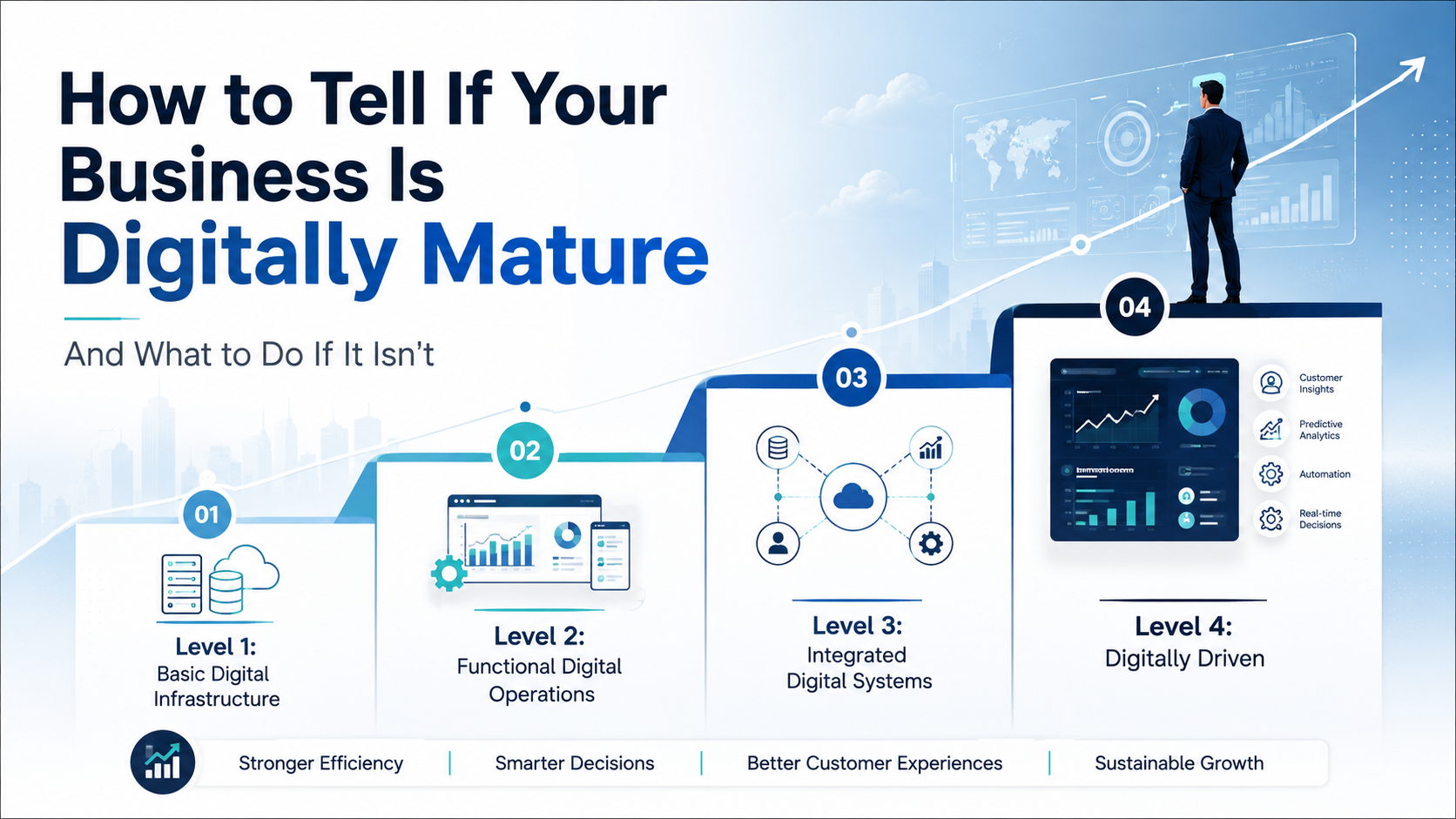
Digital maturity is having the right technology (even if not the latest) configured well, used consistently, and integrated into how the business actually makes decisions and delivers value.
A digitally mature business is faster to respond to market changes, cheaper to operate at scale, and more resilient when things go wrong. Here’s a quick map of what the different levels are, so you can see where your business sits.
Level 1: Basic Digital Infrastructure
A business at Level 1 has the foundations but has not built on them. For example:
- Your website is live but not optimized for search or conversion
- Business email and basic cloud storage in place
- Payments can be accepted digitally
- Basic social media presence exists
At this level, digital tools are used for convenience rather than as a system that drives the business. Technology is reactive rather than proactive.
Level 2: Functional Digital Operations
A business at Level 2 is using technology to manage operations more effectively. For example:
- CRM or customer management system is in place and actively used
- Digital analytics such as Google Analytic 4 are installed and basic conversion tracking is working
- Microsoft Clarity and Google search console are analzyed regularly
- Core internal processes are supported by digital tools: project management, communication, file sharing
- Email marketing is operational with basic automation in place
- IT security baseline is met: MFA, endpoint protection, managed backups
At this level, the business is no longer losing visible value to manual processes, but digital tools are operating in silos and are not yet creating compounding operational advantage.
Level 3: Integrated Digital Systems
A business at Level 3 has connected its systems and is beginning to generate real operational leverage:
- CRM, marketing tools, and analytics share data without manual transfer
- Marketing performance is measured by pipeline contribution, not just traffic and engagement
- IT oversight is proactive: monitoring, patching, and review cycles run on a schedule rather than in response to problems
- Content and digital presence are managed as an ongoing system rather than a series of one-off projects
- A disaster recovery plan exists and has been tested
Level 4: Digitally Driven
A business at Level 4 makes decisions based on digital data, uses technology to create capabilities that would otherwise require significantly more headcount, and adapts its digital systems as the business evolves:
- Leadership reviews digital performance metrics weekly and makes resource allocation decisions based on them
- Marketing, IT, and operations infrastructure is designed to scale without proportional investment
- AI-assisted workflows are in place for high-volume repetitive tasks
- Digital infrastructure is reviewed annually against strategic direction
- The business could operate for several days with any single team member absent without digital systems degrading
How to Move Up a Level
The move from Level 1 to Level 2 is primarily about putting the right tools in place. The move from Level 2 to Level 3 is about connecting the tools and building the process discipline to use them consistently. The move from Level 3 to Level 4 is about culture and leadership: treating digital infrastructure as strategic and investing in it accordingly.
Trying to jump levels rarely works. A business that attempts Level 4 strategies without Level 2 foundations produces expensive initiatives with weak foundations. The right approach is honest assessment of current level, followed by systematic investment in what is missing at the next level.
Where Most Canadian SMBs Actually Are
Based on our work with growing Canadian businesses, most sit between Level 1 and Level 2: the foundations are in place but the integration, the process discipline, and the data-driven decision-making have not yet been built.
The distance from there to Level 3 is achievable with focused effort over six to twelve months. The return on that investment, in operational efficiency, marketing effectiveness, and organizational resilience, is significant relative to the cost.
At Smartt, we help businesses identify where they are on this spectrum and build a practical path to the next level. FlexHours gives you access to the IT, marketing, and digital infrastructure expertise to close the gap without building an internal team for each discipline. Reach out to start with an honest assessment.