 Branding
 Digital Marketing
 Web & App Dev
 IT Services
The Digital Infrastructure Every Growing Property Management Company Needs
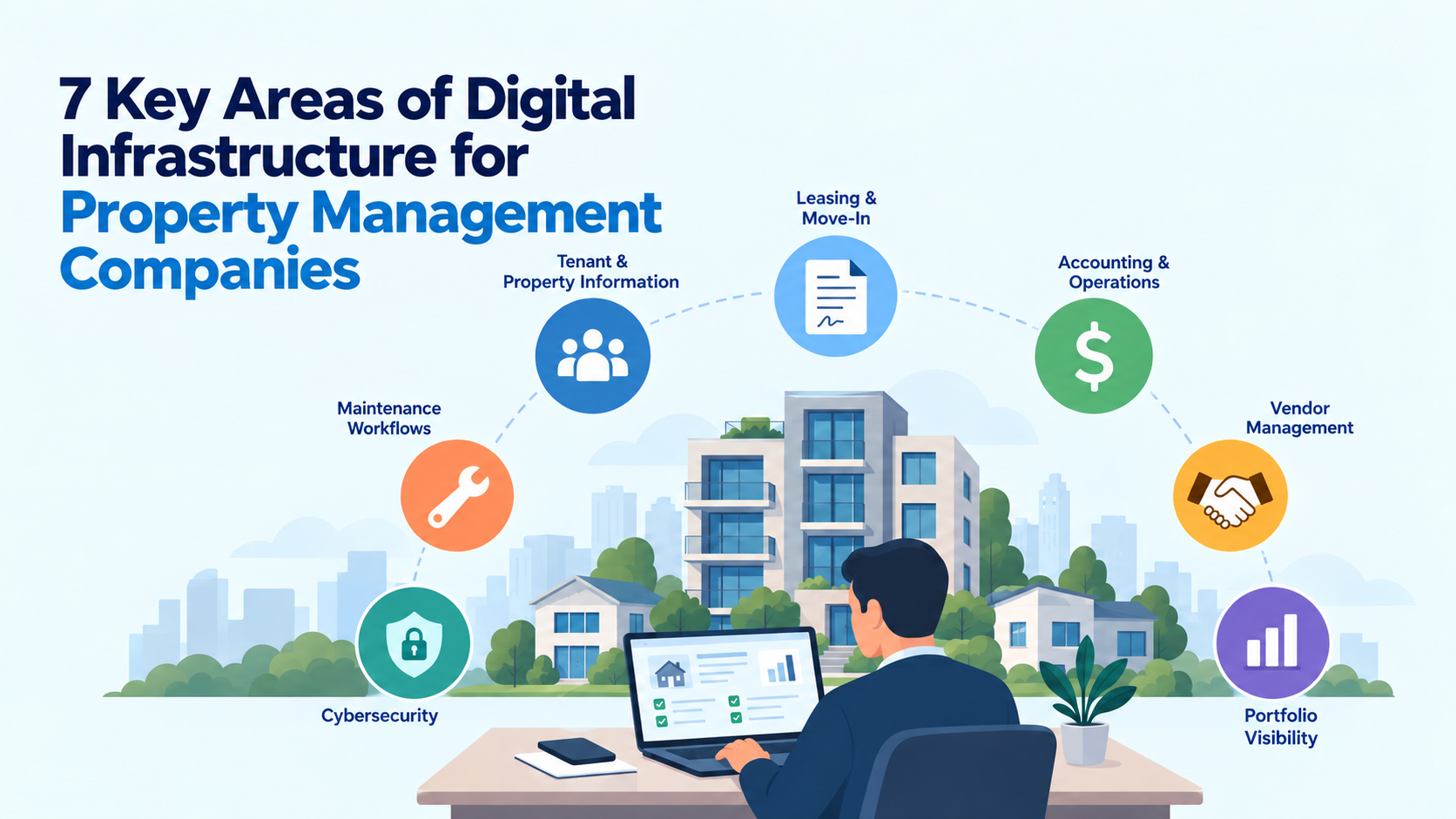
Property management companies tend to scale in complexity as they grow because every new property adds more tenant communication, maintenance requests, leases, inspections, payments, vendor coordination, and reporting. And many of them are still managing important parts of the business through a combination of email, spreadsheets, shared drives, accounting software, property management platforms, and manual processes that do not always connect properly.
That can work reasonably well with a smaller portfolio, but as the business grows, the gaps become harder to manage. We’ve seen how staff spend more time searching for information, following up on requests, entering the same information into multiple systems, and trying to figure out what still needs to be done. So over the past year or so, we have helped our clients in the property management space to make their business easier to operate by reducing manual work, improving response times, protecting sensitive information, and giving management better visibility across the portfolio.
Here are seven areas growing property management companies should review based on what have learned.
1. Centralize Tenant and Property Information
The first priority is making sure that important information is easy to find and connected to the right tenant, unit, and property.
Tenant records, lease documents, contact information, inspection reports, maintenance history, payment records, correspondence, and property documents should not be scattered across different inboxes, folders, and systems.
Staff should be able to quickly answer basic questions such as:
- Who is responsible for this unit?
- When does the lease expire?
- What maintenance has already been completed?
- Are there outstanding payments?
- Which documents relate to this property?
- What conversations have already taken place with the tenant?
If employees have to search through several systems to answer these questions, it’s going to lead to a lot of wasted time and more potential errors. better information structure reduces the amount of time staff spend looking for things and makes it easier for other employees to step in when someone is away.
2. Improve Maintenance Workflows
Maintenance is one of the most operationally complicated parts of property management.
When a tenant reports a problem, someone has to review the request, determine how urgent it is, assign the right employee or vendor, coordinate access, track the work, confirm that it has been completed, and then process the invoice. And when most of that happens through email, text messages, and phone calls, it becomes very difficult to see what is still outstanding.
A better maintenance workflow should allow the company to consistently capture requests, categorize and prioritize them, route them to the right person, track their status, store supporting photos and documents, record completed work, and connect the final invoice back to the property.
This is also one of the areas where automation can create immediate value. For example, routine maintenance requests can be categorized automatically, tenants can receive status updates without staff manually sending each message, and urgent issues can be escalated as soon as they are identified.
In our work with clients, we prefer to automate these components with deterministic code for consistency, and only use AI to help with unstructured requests (with human review). Either way, you will want to create the consistent process first, and then using automation and AI to make that process faster.
3. Automate Leasing and Move-In Processes
Leasing creates a large amount of repetitive administrative work. Applications need to be reviewed, documents need to be collected, leases have to be prepared and signed, deposits need to be tracked, move-in instructions have to be sent, and several internal systems may need to be updated.
Auch of this work can be automated. The objective is to reduce the number of steps that needs to be done manually!
4. Connect Accounting and Operations
Property management creates a constant flow of financial information, including rent payments, deposits, vendor invoices, owner payments, maintenance expenses, utility charges, late fees, and other transactions.
The operational side of the business and the accounting side should not operate as separate worlds.
Management should be able to see rent collected versus outstanding, expenses by property, maintenance costs, vendor spending, property-level profitability, upcoming payments, accounts receivable, and budget versus actual performance without having to assemble the information manually every time. If accounting staff are repeatedly entering information that already exists somewhere else, that is usually a good place to look for an integration or automation.
The same applies when operational staff have to ask accounting for information that should already be visible from the systems they use every day.
5. Standardize Vendor Management
Most property management companies rely on a large network of contractors and outside vendors, which creates another layer of information that needs to be managed properly. The company should have a clear record of approved vendors, contact information, insurance and certification documents, rates, work history, properties serviced, open work orders, invoices, and any recurring performance issues.
Vendor documents should also be monitored so that expired insurance, licences, or certifications do not go unnoticed.
A good vendor management process reduces dependence on individual employees knowing who to call, what a vendor charges, whether the required documentation is current, or where previous invoices are stored. It will also give management better information when deciding which vendors should receive more work and which ones may need to be replaced.
6. Treat Cybersecurity as Part of Property Operations
Property management companies hold a significant amount of sensitive information, including tenant information, banking details, leases, payment records, owner information, employee information, and access credentials. This information is exposed to risks such as payment fraud and business email compromise.
For example, a compromised email account could potentially be used to redirect rent payments, change vendor banking information, impersonate an owner, or convince an employee to send money to the wrong account. At minimum, property management companies should require MFA on email and financial systems.
7. Give Management Better Portfolio Visibility
As the number of properties grows, management needs a clearer view across the entire portfolio.
They should be able to quickly see occupancy, upcoming lease expirations, rent collection, outstanding balances, maintenance backlog, average response times, vacancy duration, property expenses, vendor performance, and major issues that require attention.
This is also where AI can become much more useful.
Once the underlying data is reliable and connected, management can begin asking questions such as:
- Which properties have the highest maintenance costs this year?
- Which leases expire in the next 90 days?
- Which maintenance requests have been open for more than a week?
- Which tenants have outstanding balances?
- Which vendors have the slowest completion times?
Where Should You Start?
Most property management companies should not try to replace every system at once.
A better starting point is to identify where the business is currently losing the most time, creating the most risk, or frustrating employees and tenants the most. Look at where employees are entering the same information more than once, which processes still depend heavily on email, where maintenance requests get delayed, what information takes too long to find, which tasks depend on someone remembering the next step, where management lacks visibility, and which processes create the greatest financial or cybersecurity risk.
Those problems usually point directly to the first areas worth improving.
Build the Foundation Before Adding More AI
There are now a lot of AI tools being marketed to property management companies, and some of them will be useful.
However, AI works much better when the underlying systems, workflows, and data are already organized.
If maintenance requests are scattered across email, lease information is inconsistent, accounting data is disconnected from operations, and nobody is quite sure which system contains the correct information, adding AI does not solve the underlying problem. The better approach is to first build a stronger digital foundation with connected systems, reliable data, better automation, stronger cybersecurity, and clearer management visibility.
Once that foundation exists, AI can be added where it genuinely reduces work, improves response times, or helps management make better decisions.
At Smartt, we help property management companies identify these gaps, connect systems, automate repetitive work, strengthen cybersecurity, and determine where AI can create measurable value.
Through FlexHours, property management companies can access IT, software, automation, cybersecurity, and digital expertise without having to build all of those capabilities internally.
If your property portfolio has grown faster than the systems supporting it, the next stage of growth may depend less on adding more people and more on making the business easier to operate.