 Branding
 Digital Marketing
 Web & App Dev
 IT Services
How to Write a Technology Roadmap That Non-Technical Leaders Will Actually Use
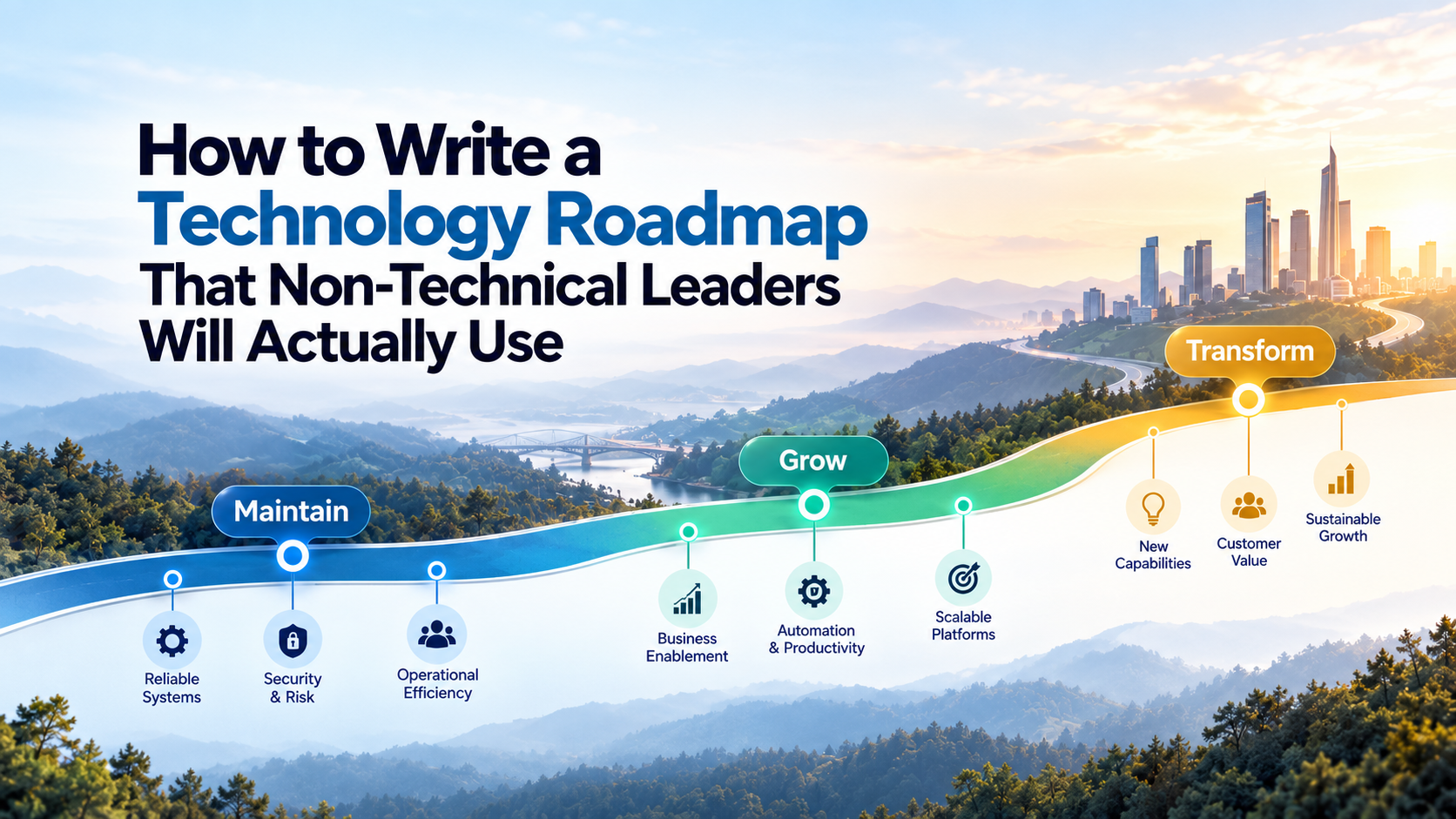
A technology roadmap can be technically accurate and still be almost useless to the executive team. IT teams naturally think about infrastructure, applications, cybersecurity, integrations, upgrades, technical debt, lifecycle management, and all of the other things required to keep systems working. Business leaders are usually thinking about something very different: growth, risk, productivity, customers, employees, cash flow, and where the company is going next.
A good technology roadmap connects those two perspectives. It should help leadership understand what the business needs to invest in, why it matters, when it should happen, what depends on what, and what happens if the company decides to do nothing for now.
The easiest way to build one is to work through the process in a clear sequence.
Step 1: Start With the Business Plan
Many IT teams feel the temptation to start by listing everything IT wants to upgrade. This is understandable, as they see the fires they want to put out first. But it’s the quickest way to become just another cost item to the executive team when it comes to budget approval.
Instead of listing upgrades, start with what the business is trying to accomplish over the next one to three years.
That may include opening new locations, expanding into another market, hiring more people, acquiring another company, launching a new service, improving margins, increasing automation, improving the customer experience, or reducing operational risk. Once those goals are clear, the next question is what technology, systems, infrastructure, data, automation, or security capabilities will be required to support them.
For example, instead of writing:
Implement mobile device management.
Write:
Create a consistent way to secure and manage company devices as the workforce grows.
Instead of:
Replace the legacy ERP system.
Write:
Remove operational bottlenecks that are making it harder to scale and get reliable management information.
This way, the roadmap explains why the problem matters to the business in the first place.
Step 2: Separate Run, Grow, and Transform
Once the business priorities are clear, identify the technology initiatives required to support them. A useful way to organize them is into three categories: Run, Grow, and Transform.
Run
These are the investments required to keep the current business reliable, secure, and operational. They may include cybersecurity, backups, hardware replacement, infrastructure upgrades, business continuity, compliance, software lifecycle management, and replacing systems that are reaching end of life.
Some of these initiatives may not feel particularly exciting, but they are still necessary because they protect the business that already exists.
Grow
These are investments that help the business support more customers, employees, locations, transactions, or operational complexity. Examples may include CRM improvements, system integrations, workflow automation, reporting, collaboration tools, application upgrades, and better data visibility.
These projects are usually about reducing friction and making it easier for the company to scale without adding unnecessary complexity or manual work.
Transform
These are the larger initiatives that materially change how the business operates or what it is capable of doing. They may include AI, major automation projects, replacing a core business platform, introducing a new digital customer experience, or creating a new operational capability that did not previously exist.
This structure is useful because it makes the purpose of each investment easier to understand. Some projects protect the business you already have, some help you grow it, and a smaller number may allow the business to do something it simply could not do before.
Step 3: Translate Every Initiative Into Business Language
Once the initiatives are identified, remove as much technical language as possible from the executive version of the roadmap. Leadership does not need to understand every technical detail, just enough information to make a decision. (The executive roadmap should help people make decisions rather than explain how every system works. Leadership does not need a detailed explanation of how a firewall is configured, but they do need to understand what risk the current environment creates, what reducing that risk is likely to cost, and whether it is important enough to address now.)
For every initiative, the roadmap should answer five basic questions:
- What are we doing?
- What business problem does it solve?
- When should it happen?
- What level of investment is required?
- What happens if we do not do it?
That is usually enough information to have a useful management discussion. The detailed architecture, implementation tasks, dependencies, vendors, configuration decisions, and technical design can live somewhere else.
Step 4: Show the Cost of Doing Nothing
Technology roadmaps often show the cost of doing something without showing the cost of not doing it, and that makes prioritization much harder.
If a cybersecurity project costs $50,000, leadership needs to understand what risk that investment is addressing. If an integration project costs $30,000, they should understand how much manual work, delay, duplication, or error it is expected to reduce. If a core system needs to be replaced, management should understand what happens if the replacement is delayed for another year.
The cost of inaction may include increased cybersecurity exposure, higher support costs, downtime, reduced employee productivity, difficulty scaling, poor customer experience, loss of vendor support, dependence on aging systems, increased manual work, or an inability to support future business initiatives.
You do not need to invent a precise dollar figure for every risk, because that can create a false sense of accuracy. You do, however, need to make the consequence understandable enough that management can decide whether accepting that risk is reasonable.
Step 5: Identify the Dependencies
Some technology investments only make sense after other work has been completed, and leadership needs to understand those relationships.
For example, the company may want to use AI across the business, but first it may need to clean up its data, organize its documents, improve permissions, or connect several systems. Management may want better dashboards, but the underlying systems may not contain reliable enough information to support them. The business may want to automate a process, but the process itself may still be inconsistent depending on who is doing the work.
These dependencies matter because they explain why foundational work often has to happen before the more visible initiative leadership actually wants. If those relationships are not made clear, necessary infrastructure or systems work can easily look like unrelated IT spending.
The roadmap should therefore show not only what the business wants to do, but also what needs to be in place first in order to make that initiative successful.
Step 6: Prioritize Ruthlessly
The executive roadmap should focus on the relatively small number of initiatives that require meaningful investment, introduce meaningful risk, support an important business objective, depend on other work being completed, or require an actual leadership decision. (Note: Routine maintenance and smaller technical tasks still need to happen, but they do not all need to appear on the leadership roadmap.)
A practical way to prioritize is to look at four factors: business impact, risk of delay, dependencies, and the effort and investment required. These criteria help leadership understand not just which projects matter, but why one project may need to come before another.
The roadmap should also make trade-offs visible. Capacity, budget, and management attention are all finite, so moving one initiative forward may mean pushing something else back. That is part of the value of the roadmap, because it forces the business to make choices instead of quietly treating everything as urgent.
Step 7: Put It Into a Simple Format
Once the priorities are clear, the actual roadmap should be simple. In some companies, even a one-page format is enough.
For each initiative, show:
- Initiative: What you are doing, in plain English.
- Business objective: What problem it solves or capability it enables.
- Category: Run, Grow, or Transform.
- Timeline: The expected quarter or general timeframe.
- Investment: A realistic budget range.
- Risk of delay: What happens if it is postponed.
- Status: Evaluating, planned, in progress, or complete.
More detailed project plans can exist underneath the roadmap, but the executive version should give leadership a clear picture of where technology investment is going, why it matters, and how the major initiatives relate to one another.
Step 8: Use the Roadmap as Part of Business Planning
The roadmap should be part of the broader business planning process. A quarterly leadership review is usually a good cadence, because it is frequent enough to catch meaningful changes without turning the roadmap into another weekly status report.
The discussion should focus on questions such as whether the business is still solving the right problems, whether the technology priorities still match where the company is going, whether anything has changed that should move an initiative forward or push it back, and whether there are business decisions coming in the next 90 days that will affect the roadmap.
It is also useful to discuss which risks the company is deliberately choosing to accept for now. Not every problem has to be fixed immediately, but there is a big difference between consciously accepting a risk and discovering six months later that nobody realized it existed.
When technology is discussed this way, IT stops being just a function that reports on what happened and becomes part of the discussion about what the business should do next.
Step 9: Keep the Near Term Detailed and the Long Term Flexible
A technology roadmap should show direction, but it should not pretend that the future can be predicted perfectly.
The next quarter should usually be fairly detailed because those initiatives are close enough to plan properly. The next six to twelve months can be less specific, while anything beyond that should generally be treated as strategic direction rather than a committed project schedule.
Business priorities change, technology changes, costs change, new risks appear, and entirely new capabilities can become practical much faster than expected. That is especially true now with AI and automation, where something that would have been unrealistic or too expensive two years ago may suddenly be worth revisiting.
A useful roadmap therefore needs enough structure to guide decisions without becoming so rigid that it cannot change when the business changes.
How Smartt Helps
At Smartt, we help businesses build and execute technology roadmaps that connect IT decisions directly to business priorities. That usually starts with understanding the current environment: what systems the business relies on, where the risks are, where people are doing unnecessary manual work, what is becoming difficult to support, and what may prevent the company from doing what it wants to do next.
From there, we can help determine what should happen first, what can wait, what depends on something else being fixed first, and where there may be opportunities to use AI or automation.
Our FlexHours program also offers discounts on hardware and software purchases, which is especially valuable in the current environment.
Get in touch if you are interested in learning more!