 Branding
 Digital Marketing
 Web & App Dev
 IT Services
How to Use Your Competitors' Digital Footprint to Improve Your Own
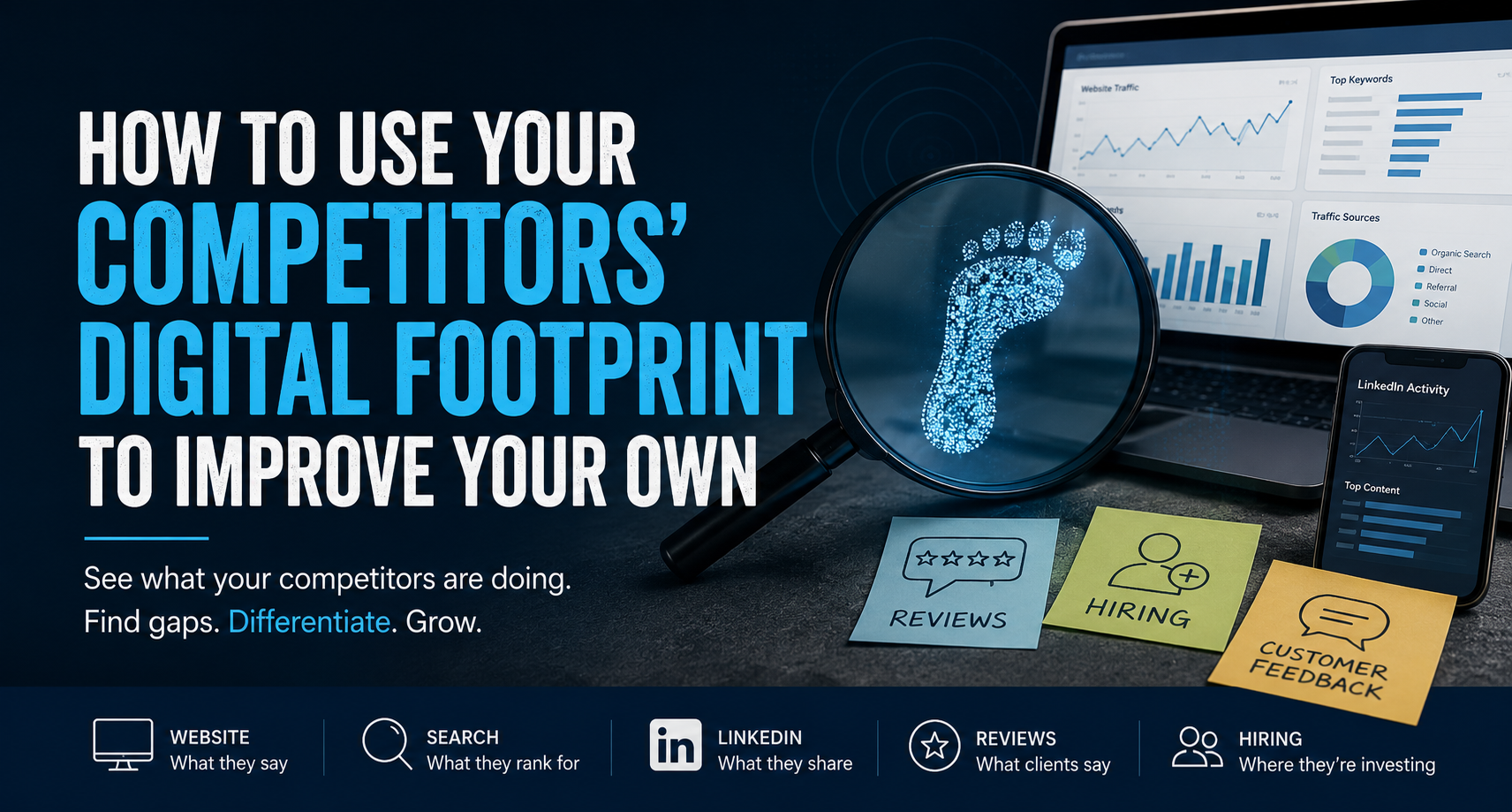
How to Use Your Competitors' Digital Footprint to Improve Your Own
To understand a client’s business so we can tailor their IT and marketing strategy, we often consider their “Company, Customers, Competitor’s.” (The good old Mckinsey 3C’s.) Of the 3, “Competitors” is often the fastest to review, as a lot of it can be doing through competitive digital analysis. Here’s a quick guide on understanding the competitive landscape you are operating in so you can make better decisions about where to invest and how to differentiate.
1. What Their Website Tells You
A competitor's website reveals their positioning, their priorities, and the audience they are trying to reach. Pretend you are a customer, and from that perspective, ask:
- What promise does their homepage make? Is it specific or generic?
- Which services are featured most prominently? What does this suggest about where they see their strongest opportunity?
- What does their language say about the client they are targeting? Who are they clearly writing for?
- What social proof do they use? Case studies, testimonials, client logos? How specific are they?
Then switch back to your own perspective and ask: what does their website do that yours does not? What does yours do better? Where is the gap you can widen?
2. What Their Search Presence Tells You
Google search results alone can reveal what your competitors rank for and what content they have invested in:
- Search the primary terms your buyers use and note which competitors appear and in what positions
- Look at the content pages that rank for them: what topics have they covered that you have not?
- Search their brand name and review the content they have produced: blog posts, guides, case studies
- Note the terms where you outrank them and the terms where they outrank you
This analysis tells you where there is an opportunity to create content or optimize pages to capture search traffic that is currently going to a competitor.
3. What Their LinkedIn Presence Tells You
A competitor's LinkedIn company page and the personal profiles of their leadership team reveal their messaging priorities, their content strategy, and the type of expertise they are trying to be associated with.
- What topics do they post about? What questions are they trying to answer for their audience?
- What gets the most engagement on their posts?
- What are their leadership profiles saying about their areas of focus?
- Are they actively hiring? For what roles? This reveals where they are investing.
4. What Their Reviews Tell You
Google reviews, Clutch profiles, and other public ratings surfaces are among the most valuable competitive intelligence available. Reviews tell you what clients actually valued and what disappointed them.
- Read the positive reviews: what do clients consistently praise? Are these areas where you are also strong, or gaps in your own positioning?
- Read the negative reviews: what do clients complain about? These are opportunities to explicitly differentiate by excelling where the competitor struggles.
- Note the recency of reviews: a competitor with many old reviews and few recent ones may be losing client satisfaction momentum.
Optional: In the age of AI, you can ask AI to help summarize the reviews into a list of what’s important to buyers.
5. What You Should Not Do With This Information
Keep in mind: as tempting as it may be, do NOT use the competitive analysis as as a template to replicate. Instead, use it as an input to your own positioning. A competitor's content strategy works for them because it is connected to their positioning, their audience, and their capabilities. Copying their approach without that context produces a pale imitation that confuses your own audience.
The useful output of competitive analysis is:
- A clearer understanding of where the market is being served well and where it is not
- Specific opportunities to differentiate in areas where competitors are generic or weak
- Content and channel gaps you can close with less competition
- Positioning language that explicitly separates your offering from what competitors are saying
The Intelligence Is Already Visible
Most SMBs do not conduct systematic competitive analysis because it feels like it requires specialized tools or significant time. The reality is that an hour of structured observation of a competitor's digital presence produces more useful insight than most formal research exercises.
At Smartt, we include competitive landscape review as part of how we approach marketing strategy for clients. If you want a structured analysis of your competitive digital environment, reach out and let’s have a conversation.